Why Surfacing Choice Matters for Industrial Outdoor Storage
When a GTA facility expands its outdoor storage — container stacks, steel coil racks, pallet yards, equipment laydown areas, trailer parking — the surfacing decision gets made too quickly, often by default ("just put gravel down, it's cheaper"). Six months later, operators are dealing with rutting, standing water, dust complaints from neighbours, or a municipal inspector asking why an unpaved area is being used for something the site plan agreement specifies should be hard-surfaced.
The right surface depends on load type, traffic frequency, drainage design, and what your municipality's site plan control or zoning bylaw actually requires for the use. This guide compares the three common options for industrial yards in Brampton, Mississauga, Vaughan, Caledon, and Toronto, with realistic 2026 costs.
The Three Main Options
Compacted Granular (Gravel)
A well-built gravel yard is engineered, not just dumped stone. It typically means a geotextile separation layer over subgrade, then 300–450 mm of compacted granular A and B material, crowned and graded to drain. Gravel is the lowest upfront cost and drains well if graded properly, but it generates dust in summer, ruts under repeated heavy point loads (container corner castings, outrigger pads, crane mats), and needs periodic regrading and top-up stone.
Gravel suits low-traffic overflow storage, laydown areas for materials that aren't moved often, and sites where the use is genuinely temporary or seasonal — but many municipalities will not approve gravel as the permanent surface for active outdoor storage under a site plan agreement.
Asphalt
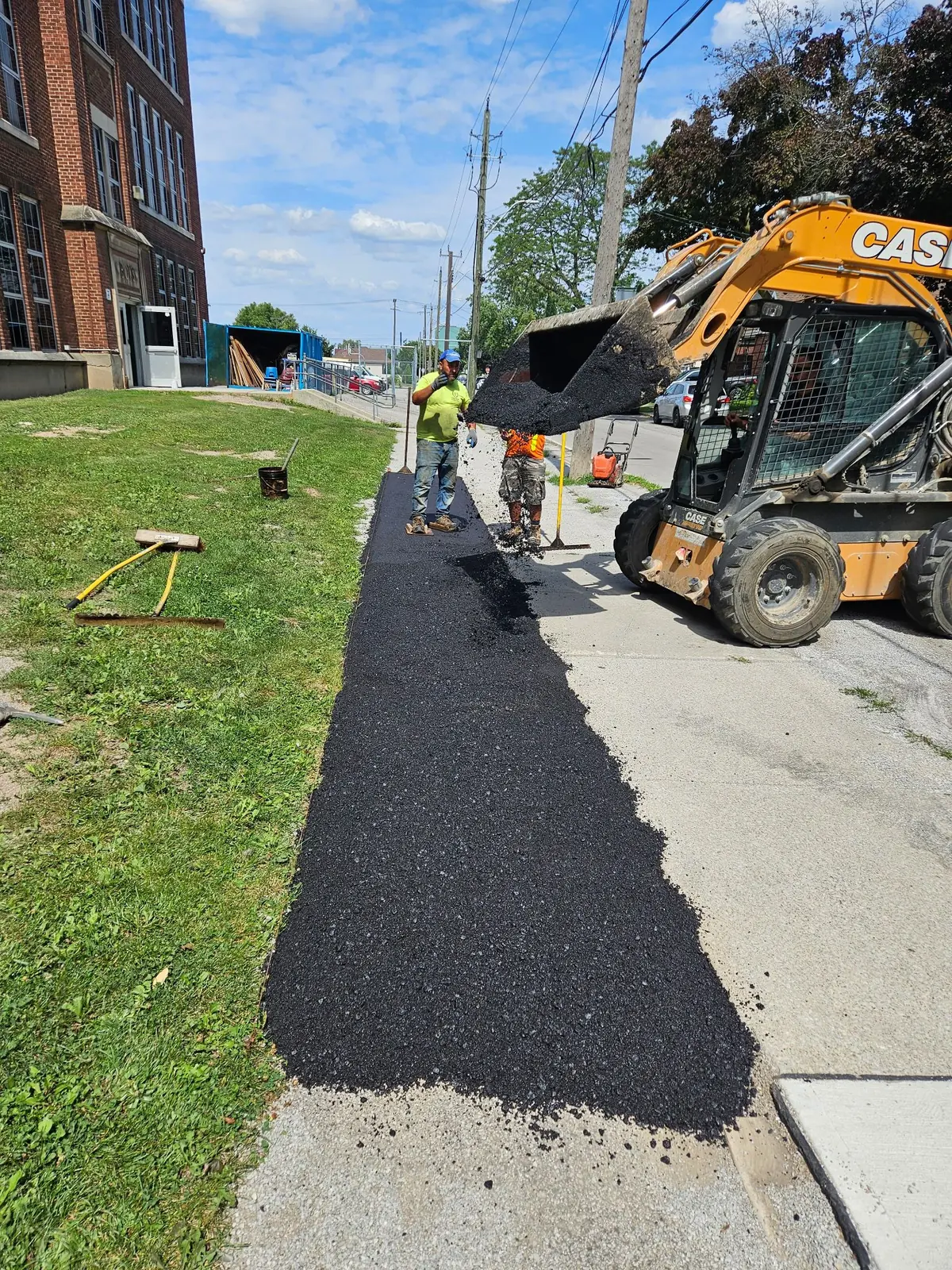
Industrial-grade asphalt (typically a granular base of 300–450 mm topped with a 40 mm binder course and a 40–50 mm HL3/Superpave wear course, sometimes thicker in truck travel lanes) is the most common choice for yards with regular forklift, trailer, and truck traffic. It's more durable than gravel, sheds water predictably when graded to catch basins, and handles rolling loads well — but it's more vulnerable to point loads and fuel/oil exposure than concrete, and freeze-thaw cycling in the GTA climate will eventually produce alligator cracking and potholes if drainage or base compaction was inadequate.
For a deeper comparison of asphalt specs for heavy equipment versus standard commercial paving, see our guide on truck-rated vs. standard asphalt for industrial yards.
Concrete
Reinforced concrete (150–200 mm, steel mesh or rebar, control joints cut at regular intervals) is the highest-cost, longest-lifespan option. It's the right call for areas with concentrated point loads — container corner posts, dunnage, jack stands, crane outriggers, steel coil cradles — and for areas exposed to hydraulic fluid, fuel, or de-icing salt that would degrade asphalt binder faster. Concrete doesn't rut under static heavy loads the way asphalt can, and it tolerates freeze-thaw better when properly air-entrained and jointed.
2026 Cost Comparison (Installed, CAD per sq ft)
| Surface Type | Typical Install Cost | Expected Lifespan | Best Suited For |
|---|---|---|---|
| Compacted gravel | $3 – $6 | 5–10 yrs (with regrading) | Low-traffic overflow storage, temporary laydown |
| Industrial asphalt | $8 – $14 | 15–20 yrs | General yard traffic, trailer parking, forklift travel lanes |
| Reinforced concrete | $14 – $22 | 25–40 yrs | Point-load storage, fuel/chemical exposure, crane pads |
These are rough 2026 estimates for the GTA and vary with base depth, access/mobilization, drainage tie-ins, and site prep (demolition, grading, geotextile). Large yards often use a hybrid approach — concrete pads under racking, cranes, and container stacks, asphalt for travel lanes, and gravel for seasonal overflow only.
Load, Traffic & Point-Load Considerations
The surfacing failure we see most often in GTA industrial yards isn't from general traffic — it's from static point loads sitting too long on a surface designed for rolling loads. A loaded shipping container's corner castings concentrate enormous pressure on a tiny footprint. Asphalt, especially in warm weather when the binder softens, will slowly indent under that load. Concrete distributes the load across its reinforced slab and resists indentation.
Before finalizing a surfacing plan, map out:
- Where containers, trailers, or racking will sit long-term vs. where equipment only passes through
- Axle loads and tire pressures of the heaviest vehicles using the yard regularly
- Whether any area will see fuel, hydraulic fluid, or chemical spills
- Frequency of snowplowing and salt application in winter
- Any outdoor storage of materials subject to Ontario fire code setback or surfacing requirements
If your yard also includes equipment pads or containment curbing for tanks and generators, see our related post on concrete equipment pads and spill containment.
Drainage, Freeze-Thaw & Frost Heave
Whatever surface you choose, it fails faster without proper grading and subsurface drainage. The GTA's freeze-thaw cycle is unforgiving: water that pools on a flat or poorly graded yard surface penetrates cracks or granular joints, freezes, expands, and accelerates cracking or heaving every winter. A yard graded at roughly 1–2% slope toward catch basins or swales, with a properly compacted base free of organic material, will outperform a flatter, cheaper installation by years regardless of surface type.
We cover this in detail in our post on industrial yard drainage and grading — it's worth reading alongside any surfacing decision, since drainage design should be settled before the surface is chosen, not after.
Municipal & Zoning Considerations
Outdoor storage yards in Brampton, Mississauga, Vaughan, and Toronto are typically subject to site plan control agreements that specify surfacing, screening, and stormwater requirements for the approved use — these conditions are set at the time of development approval and vary site by site. Common requirements we see include:
- Hard-surfacing (asphalt or concrete) required for any area used for active outdoor storage, vehicle parking, or loading, as opposed to gravel
- Dust suppression measures for any remaining unpaved yard areas
- Stormwater management tied to surface type — impervious surfaces (asphalt, concrete) may trigger different catch basin, oil-grit separator, or stormwater fee obligations than permeable gravel
- Fire route pavement and signage requirements if emergency vehicle access crosses the storage yard
Because these conditions are specific to each site's approved plans and can differ significantly between municipalities, always confirm requirements with your municipality's planning or building department before resurfacing or converting a gravel area to active storage use. Retroactively paving an area that was approved as gravel (or vice versa) can trigger a site plan amendment.
Choosing the Right Surface: A Quick Checklist
- Identify which yard zones carry static point loads (containers, racking, cranes) vs. rolling traffic only
- Check your site plan agreement for surfacing requirements before changing anything
- Confirm drainage grading and catch basin capacity before finalizing surface type
- Budget for a hybrid surface (concrete under point loads, asphalt for lanes) if the yard has mixed use
- Factor in winter maintenance — plowing damages gravel edges and asphalt patches faster than concrete
- Get a geotechnical read on subgrade soil if the area has history of soft spots or standing water
Maintenance & Lifecycle Planning
Gravel yards need annual regrading and stone top-up, especially in travel lanes and gate areas. Asphalt needs crack sealing every 2–3 years and a sealcoat cycle to protect against fuel and UV degradation, with resurfacing typically needed at the 15–20 year mark. Concrete needs joint sealant maintenance and occasional slab replacement where point loads have caused localized cracking, but generally requires the least frequent intervention over a 25+ year horizon.
For facilities budgeting capital expenditures, it's worth modelling total cost of ownership rather than just install price — a $6/sq ft gravel yard that needs full rebuilding every 7–8 years can cost more over 25 years than a $14/sq ft asphalt surface installed once and properly maintained.
A site assessment that accounts for your specific load profile, drainage, and municipal obligations is the only reliable way to land on the right surface mix for your yard.
Related Services