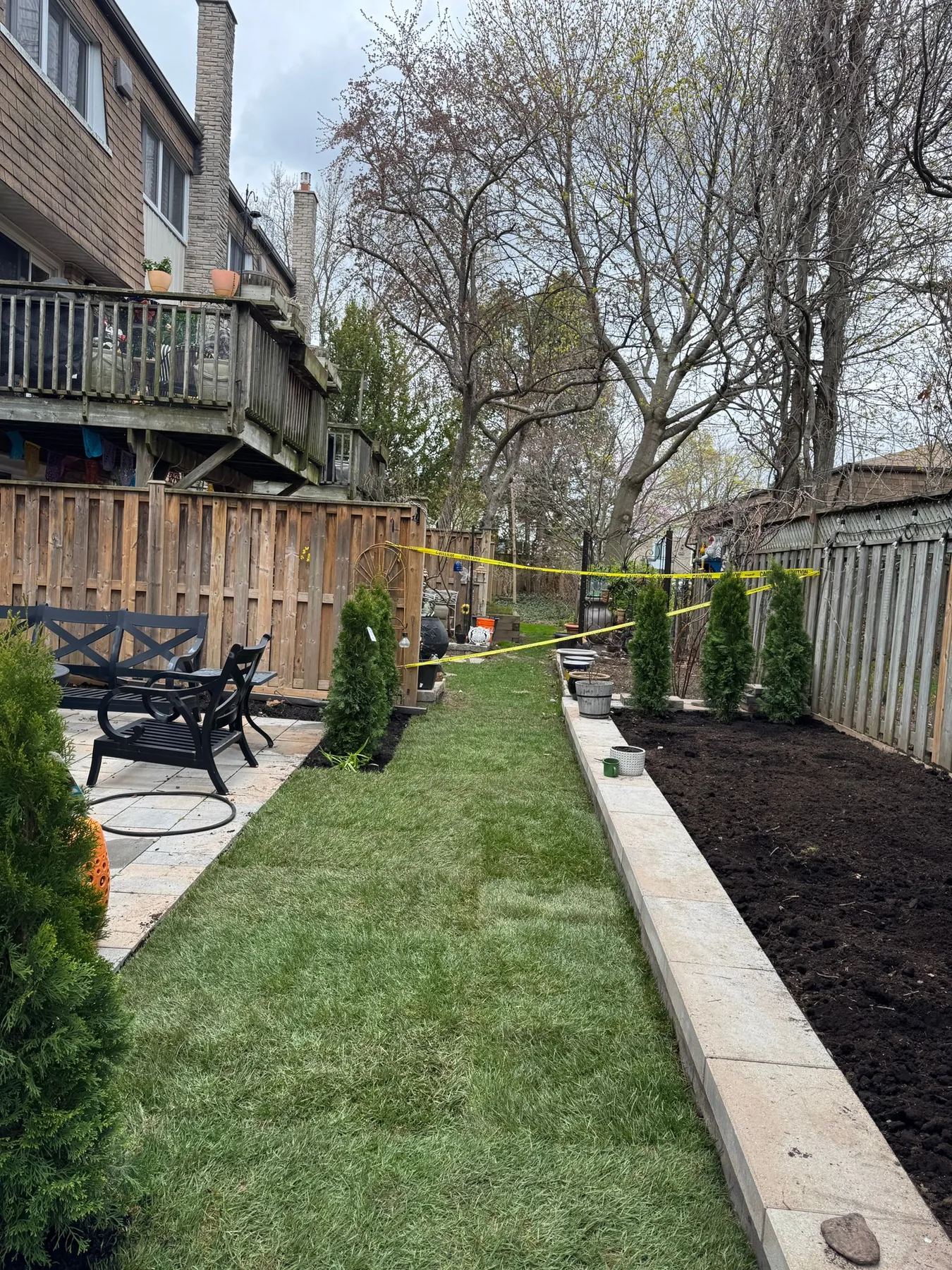
Timing changes the outcome of almost every landscaping project. The exact same sod laid in late May versus mid-July has dramatically different odds of taking root. The exact same garden bed planted in September versus mid-summer survives the first winter at very different rates. Here's a season-by-season guide for GTA homeowners — what to do when, and what to avoid.
Why timing matters
The GTA has a defined growing window: roughly mid-April to mid-November, with the most plant-friendly stretches in late April–early June and late August–late October. Outside those windows, the soil is either too cold, too hot, too dry, or about to freeze. Planting against the calendar means more watering, more loss, and more replanting in year two.
Hardscape elements (retaining walls, patios, dry-stack stone) don't care about the growing season, but they do care about frost — and that gives you a different schedule.
Sod: late April–early June, and late August–early October
Sod has two windows in the GTA, and they're not equal.
Late April through early June is the best window. Soil is warm enough for root growth, daytime temperatures are mild, and rainfall is reliable. Sod laid in this window will be fully rooted within 14–21 days with normal watering.
Late August through early October is the second window, almost as good. Soil is still warm but the air is cooler, which reduces transpiration stress on freshly laid sod. The risk is a sudden early cold snap — if the sod doesn't establish before the first hard freeze, much of it dies. The further into October you go, the higher the risk.
Mid-summer sod (July–August) is doable but only with twice-daily watering for 14–21 days and ideally a temporary shade cloth. It costs more in water and effort and has a noticeably higher failure rate.
If you can possibly wait until September for a July project, do it. Reformity's landscaping crew regularly recommends pushing sod jobs to the better window unless the homeowner has a specific reason to act now.
Garden beds and plantings: spring or fall, not summer
Spring planting (late April–early June) gives plants a full season to establish before winter. Most native perennials, ornamental shrubs, and small trees benefit.
Fall planting (late August–late October) is actually better for many woody plants — shrubs, ornamental trees, hedges. The plant focuses energy on root growth instead of leaf production, soil is still warm, and there's typically more reliable rain than mid-summer. Fall-planted shrubs frequently outperform spring-planted ones in their first summer.
What to avoid: July and August plantings. Heat stress is real and plants put into the ground in those months need three times the water and lose 15–30% to transplant shock.
Retaining walls: any time the ground isn't frozen
Retaining wall builds — segmental concrete blocks (Allan Block, etc.), natural stone, gabion — don't depend on the growing season. The constraint is frozen ground: footings need to be excavated below the frost line (1.2 m in the GTA), and you can't dig frozen soil productively. That gives a wall-build window roughly mid-March through late November in most GTA winters.
We often schedule wall builds for early spring (March–April) and late fall (October–November) precisely because the growing-season slots are fully booked with sod and planting projects. A wall built in early April is settled and ready for plantings by mid-May.
Hardscaping (patios, walkways, interlocking): March–November
Same general logic as retaining walls — frost is the only enemy. Interlocking can be installed any time the ground is workable. We've poured concrete patios into early December and laid interlocking in late March.
Two timing considerations specific to hardscape:
- Sealing interlocking pavers should be done at least 6–12 months after install (lets joint sand cure and any natural efflorescence resolve). If your interlocking goes in this fall, plan to seal next fall.
- Concrete patios need 7+ days of cure time before heavy use, and the cure is slower in cold weather. A concrete patio poured in November may not be fully usable until mid-spring.
For homeowners planning a combined hardscape + landscape project, the optimal sequence is: hardscape in early spring, plantings and sod in late spring, or hardscape in late fall, plantings the following spring.
Tree planting: late April–early June, late August–late October
Mature tree planting is one of the highest-impact landscaping investments a homeowner can make — and one of the most timing-sensitive. Trees planted in mid-summer have noticeably higher mortality rates than trees planted in either shoulder season.
For deciduous trees (maple, oak, locust, redbud) the best windows are early spring before bud break and fall after leaf drop. The tree is dormant, so the move stresses it less.
For evergreens (cedar, spruce, pine) late August through late September is the gold standard window — soil still warm enough for root growth, no heat stress, plenty of time before winter.
A young tree planted in the wrong window can be replaced. A 6-foot specimen tree planted in the wrong window costs $400–$1,200 to redo. Time it right.
What NOT to do in mid-summer
A short list of mid-summer landscaping projects to avoid unless you have no choice:
- New sod (without aggressive watering plans)
- Tree planting (especially evergreens)
- Major bed planting (perennials struggle)
- Pruning major flowering shrubs (timing-sensitive; mid-summer pruning often removes next year's bloom buds)
- Heavy fertilization (encourages new growth that can't keep up with summer heat)
What's fine in mid-summer:
- Hardscape (retaining walls, patios, walkways)
- Maintenance pruning (sucker removal, dead branches)
- Mulching established beds
- Container planting
- Irrigation system installs
Booking far enough ahead
Here's the practical reality of GTA landscaping bookings:
- Spring window (April–June): book in January–February. By March, most established crews are full.
- Fall window (September–October): book in June–July. The good crews are taking deposits by August.
- Hardscape in shoulder seasons (March, November): book 4–8 weeks ahead.
If you call a landscaping company in late April asking to put in sod in May, expect to be slotted into late June or July. The best work goes to homeowners who book ahead.
Reformity's seasonal scheduling
We run a four-season landscape calendar:
- March–April: retaining walls, hardscape prep, drainage corrections, spring tree planting
- May–June: sod installs, garden bed plantings, ornamental tree planting
- July–August: maintenance work, hardscape continues, container planting, irrigation
- September–October: fall sod, shrub and tree planting, hardscape catches up on backlogs
- November: late hardscape, retaining walls, cleanup, planning for spring
We over-book the shoulder seasons (March and November) deliberately because that's when the calendar is least crowded and clients usually get faster start dates.
How Reformity quotes landscaping
Every landscape quote from us starts with a free on-site walk. We map drainage issues (these almost always need to be solved before plantings), measure proposed bed areas and turf areas, and walk through plant selection appropriate to your sun exposure and soil. The written quote includes:
- Plant species and sizes
- Sod variety and square footage
- Hardscape lines (walls, edging, paths)
- Soil amendment plan
- A written first-year care plan
- Recommended start date based on the season and your project type
We don't ship rough estimates. The price you receive is the price you pay, scope-locked.
Ready to plan your project?
Whether you're doing a sod refresh, a full backyard transformation, or a hardscape-first project that needs plantings the following spring, request a free on-site consult. We work across the GTA and the right time of year for your specific project starts with a real conversation, not a calendar.
Related Services