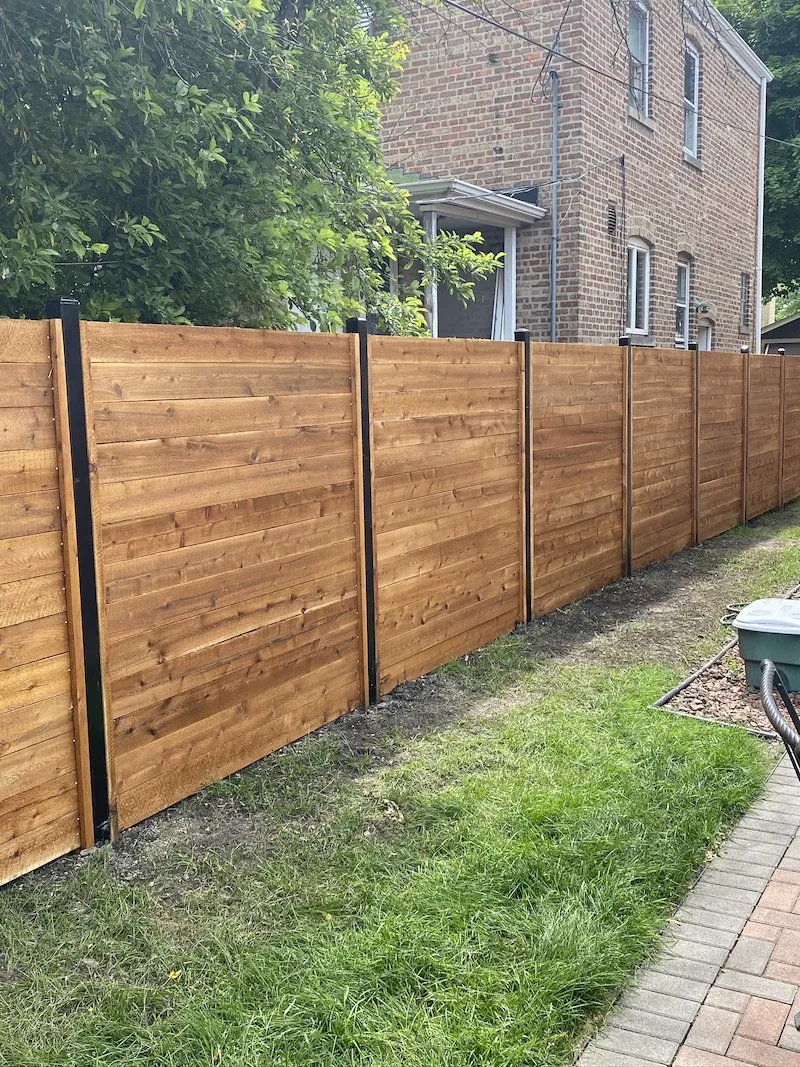
Cedar or vinyl — it's the fork in the road on almost every fence quote we write. Both are great products. They look different, they cost different amounts, and they age differently in a Canadian climate. Here's the honest comparison, based on hundreds of installs across the GTA and what we've seen them look like ten, fifteen, twenty years later.
The 30-second answer
Cedar wins on natural appearance and resale "wow factor" for the first 5–10 years; it needs maintenance to keep that look, and it lasts 20–25 years total.
Vinyl wins on low maintenance and consistency over 25+ years; it's slightly less visually striking when new but doesn't fade or warp, and the lifetime cost-of-ownership math usually favours it.
If you'll do the maintenance and love a natural wood fence — go cedar. If you want to install it and forget about it — go vinyl.
Cedar fence lifespan
A properly built western red cedar fence in the GTA lasts 20 to 25 years. The post is almost always the failure point — even cedar posts rot at the soil line within 15–18 years. We extend life by using pressure-treated 6×6 posts (set below the frost line, 4 ft minimum) and cedar boards above grade — call it a "hybrid" build. With that approach, the visible fence is cedar, the structural part is PT, and the fence lasts closer to 25 years.
The cedar boards themselves silver from honey-gold to driftwood-grey in the first 18 months in GTA sun. That colour change is permanent unless you stain immediately.
Vinyl fence lifespan
A quality vinyl fence — from Fortress, Bufftech (CertainTeed), or Eastern Wholesale — lasts 30+ years with no real maintenance beyond a pressure wash every couple of seasons. UV inhibitors built into modern vinyl prevent the yellowing that early-generation vinyl had a reputation for. We have vinyl fences from 2008 and 2009 jobs still in the field, and they look essentially identical to install day.
The failure mode for vinyl is mechanical: a tree limb or hockey-puck-velocity ball can crack a panel, and individual cracked panels are replaceable in 30 minutes if you've kept the receipt and the manufacturer still makes the line.
Maintenance: the honest comparison
Cedar maintenance reality:
- Year 1: stain or seal immediately if you want to keep the warm wood colour. Otherwise it silvers.
- Year 3–4: pressure wash (light), inspect for warped or split boards, replace one or two if needed.
- Year 6–7: full re-stain (1 day of work for a typical fence) or accept the grey.
- Year 10–12: replace 4–8 worst boards, re-stain.
- Year 18–20: post replacement begins; budget for a major refresh.
Total maintenance hours over 20 years: ~30–50 hours of homeowner time, plus stain costs ($150–$300 per re-stain).
Vinyl maintenance reality:
- Year 1: do nothing.
- Year 3: pressure wash if it looks dusty.
- Year 7: pressure wash if it looks dusty.
- Year 12: pressure wash if it looks dusty. Possibly replace one panel if something hit it.
- Year 20: still pressure wash, maybe replace a panel.
Total maintenance hours over 20 years: ~10 hours, mostly pressure washing.
Winter performance
Both materials handle GTA freeze-thaw fine if installed correctly. The failure mode in either case is frost heave on under-buried posts, not material failure.
Cedar in winter: boards can shrink slightly during the dry winter months, then swell back in spring. A 1/4-inch gap may open at the bottom of some boards — this is normal and closes again in May. Salt spray from sidewalks shortens the life of cedar boards within ~2 ft of the ground, but doesn't damage hot-dipped galvanized fasteners.
Vinyl in winter: dimensionally stable. No issue with salt. The only winter concern is a very heavy snow load against an aluminum or vinyl fence — a snow plow piling 4 ft of snow against it can flex panels temporarily, but they return to shape.
Curb appeal and resale
Recent GTA real estate market signals (Brampton, Mississauga, Vaughan, Oakville):
- A new cedar fence delivers the strongest "I'd pay more" reaction at open houses — there's something about real wood that staged buyers respond to.
- A 5–10 year old cedar fence that hasn't been maintained reads as "deferred maintenance" and slightly hurts perceived value.
- A new vinyl fence reads as practical and clean; doesn't generate the wow but doesn't hurt anything.
- A 5–10 year old vinyl fence still looks new and is essentially neutral on appraisal.
If you're selling in the next 2–3 years and the budget supports it: cedar, installed fresh. If you're staying long-term: vinyl pays you back through pure absence of upkeep.
Cost of ownership over 20 years
Let's compare a 150-foot perimeter privacy fence:
Cedar build (with PT 6×6 posts):
- Install: $13,500
- Stain at year 1: $250
- Re-stain at years 5, 10, 15: $250 × 3 = $750
- Board replacement at year 10: $700
- Major refresh at year 18 (posts + worst boards): $4,200
- 20-year total: ~$19,400
Vinyl build:
- Install: $18,000
- Pressure wash supplies over 20 years: $100
- Panel replacement (assume 1 panel hit): $350
- 20-year total: ~$18,450
Vinyl ends up slightly cheaper across 20 years and you spent zero weekends staining.
Privacy, design, and "feel"
A few notes that are more aesthetic than technical:
- Cedar has natural grain variation — every section looks slightly different. People who like that find vinyl "plasticky."
- Vinyl is uniform — every section is identical. People who like that find cedar "messy."
- Sound deadening: cedar slightly outperforms vinyl on traffic-noise reduction, mostly because cedar is denser.
- Heat: dark vinyl panels heat up significantly in summer sun — choose lighter colours if your fence faces full south.
- Dogs: vinyl is dog-proof. Cedar boards get chewed at the corners by enthusiastic dogs in the first year. Aluminum is the only truly dog-proof choice if it's a serious concern.
Reformity's recommendation by scenario
- Forever home, no time for stain weekends: vinyl.
- Forever home, love a real wood look, willing to stain: cedar (with PT posts).
- Investment property: vinyl. Tenants don't maintain wood.
- Selling within 3 years: new cedar at install — looks the best in listing photos.
- Pool enclosure: typically aluminum for code compliance, with vinyl or cedar elsewhere on the lot.
- Heritage neighbourhood: cedar. Vinyl rarely matches a heritage streetscape.
How Reformity builds either material
We over-engineer the foundation on every fence build, regardless of material:
- Posts set below the frost line (4 ft minimum in the GTA)
- Concrete-set posts with proper drainage so water doesn't pool in the post hole
- Hot-dipped galvanized fasteners on cedar; manufacturer-supplied hardware on vinyl
- PT 6×6 posts under cedar boards (the hybrid approach)
- 2-year workmanship warranty in writing on every fence
If your project also includes a pool, we know the pool enclosure code cold and can integrate the pool fence into the perimeter design.
Ready to decide?
If you're choosing between cedar and vinyl for a real project, book a free on-site visit. We'll measure, look at sightlines, talk maintenance honestly, and price both options side by side so you can compare. We work across the GTA and respond to every request within one business day.
Related Services