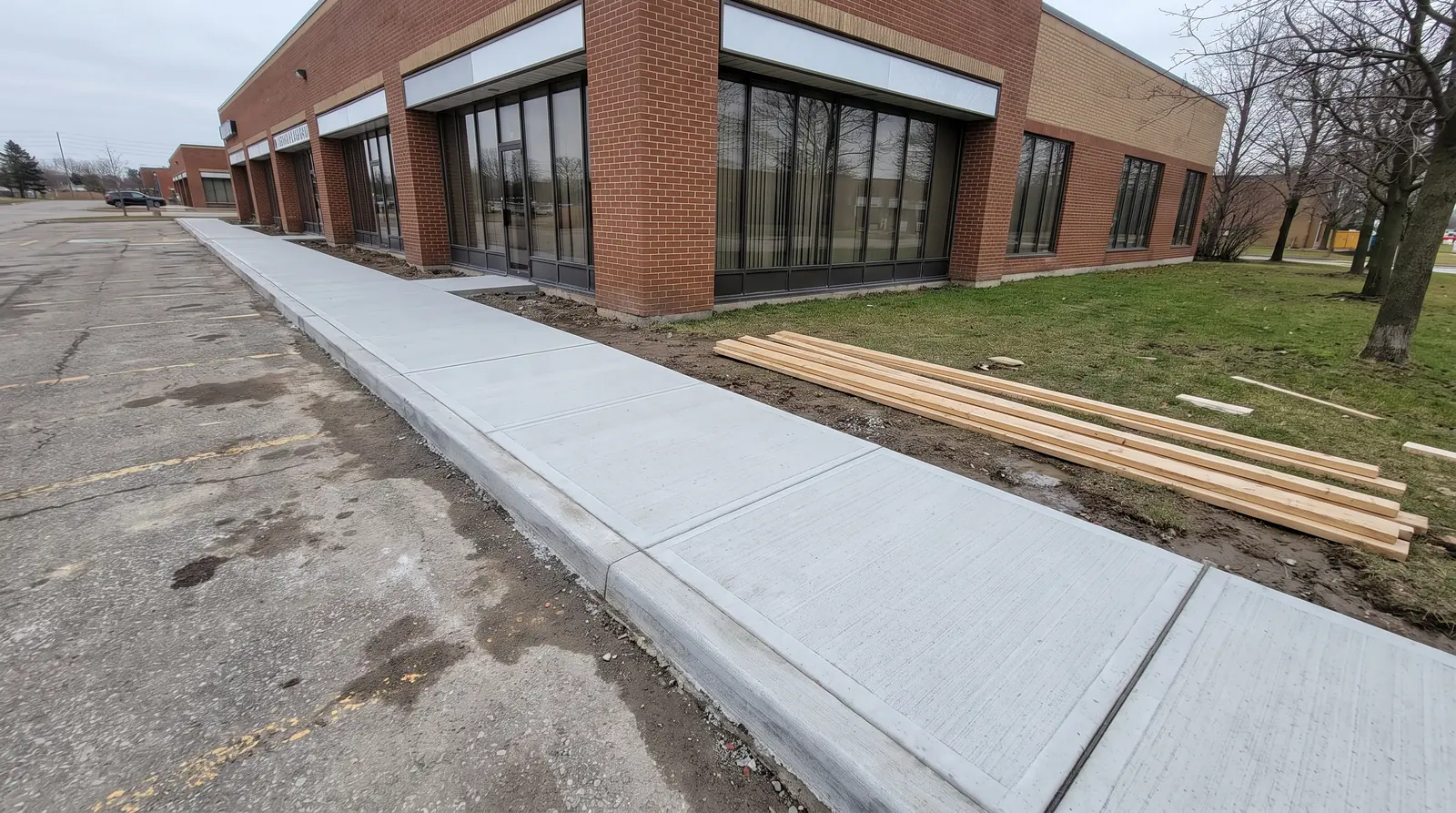
Commercial and multi-residential property managers rarely think about their sidewalks until someone falls on one. But cracked slabs, heaved joints, and settled walkways are among the most common sources of slip-and-fall claims against GTA property owners — and unlike snow and ice, a deteriorating concrete surface is a year-round liability that builds slowly and is entirely preventable with routine inspection and timely repair.
This post covers how trip-hazard risk is typically assessed, who is responsible for the sidewalk in front of your building, what municipal permits apply, and realistic 2026 repair costs for GTA commercial properties.
Who's Responsible: Your Walkway vs. the Municipal Sidewalk
Most commercial sites have two distinct types of concrete pedestrian surfaces, and responsibility differs:
- Private walkways, plaza aprons, and entrance pads on your property are entirely the owner's/property manager's responsibility to maintain and insure.
- Public sidewalks running along the municipal road allowance (the boulevard) are generally owned and inspected by the municipality, but in Toronto, Mississauga, Brampton, and Vaughan, adjacent property owners are commonly required to keep them clear of snow/ice and, in some cases, share responsibility for damage caused by their own infrastructure (tree roots from privately planted trees, driveway crossings, utility cuts).
Because boundary lines between "your" concrete and "the city's" concrete are not always visually obvious, it's worth confirming with your municipality's right-of-way or transportation services department before assuming a cracked section isn't your problem. If a tenant or visitor is injured on a walkway your business controls or maintains — even one technically owned by the city — you can still be named in a claim under the Occupiers' Liability Act if you had notice of the hazard and failed to act.
What Counts as a Trip Hazard
There's no single Ontario-wide bylaw number that defines a "trip hazard" in exact millimetres for private commercial property, and rules can vary by municipality for public sidewalks — but insurers, engineers, and municipal sidewalk inspection programs commonly use a vertical offset of roughly 10-13 mm (3/8" to 1/2") or greater between adjacent slabs as the threshold at which a joint is flagged for repair. Anything at or beyond that range is a strong candidate for grinding, mudjacking, or replacement. Confirm specific thresholds with your municipality and your insurer, since practices vary.
Other common hazard conditions include:
- Cracks wider than roughly 1 cm with separation or spalling
- Slabs sloped enough to pool water and ice in winter
- Exposed rebar or aggregate from surface deterioration
- Uneven transitions at ramps, curb cuts, or expansion joints
- Root heave near boulevard trees
If your site has accessible parking, ramps, or path-of-travel requirements under the Accessibility for Ontarians with Disabilities Act, walkway condition is also part of ongoing compliance — see our companion post on accessibility compliance for commercial properties for ramp and slope specifics.
Repair Methods and 2026 Cost Ranges
Not every trip hazard requires full replacement. Matching the repair method to the severity of the damage keeps costs down and minimizes disruption to tenants and foot traffic.
| Repair Method | Best For | Typical 2026 Cost | Lifespan Added |
|---|---|---|---|
| Diamond grinding (leveling a raised edge) | Minor offsets (10-25 mm) | $15-$30 per linear foot | 5-8 years |
| Mudjacking / slab leveling | Settled slabs, no cracking | $8-$15 per sq. ft. | 5-10 years |
| Joint/crack sealing | Preventive maintenance | $3-$6 per linear foot | 2-4 years |
| Partial slab replacement | Cracked, spalled, or heaved single slabs | $12-$20 per sq. ft. | 15-20 years |
| Full walkway replacement | Widespread failure, multiple slabs | $10-$18 per sq. ft. (larger scope discount) | 20-25 years |
| Interlocking paver conversion | Aesthetic upgrade + easier future repair | $18-$28 per sq. ft. | 20-25 years (individual pavers replaceable) |
Estimates assume standard broom-finish concrete, daytime access, and no major excavation or utility conflicts. Underlying issues like poor drainage or tree root intrusion add cost and should be addressed at the same time — see our post on industrial and commercial grading concerns for how subsurface water contributes to slab movement, a dynamic that affects commercial sites just as much as residential ones.
Municipal Permits for Boulevard Work
If your walkway repair extends into the municipal right-of-way — including sidewalk sections, curb cuts, or driveway aprons connecting to the road — most GTA municipalities require a right-of-way or boulevard permit before work begins. Requirements and fees differ:
- Toronto generally requires a permit through Right-of-Way Management for any work touching the boulevard, plus possible road occupancy permits if lane or sidewalk closures are needed.
- Mississauga and Brampton typically require a road/boulevard occupancy permit for sidewalk or curb work, with inspection before backfill.
- Vaughan requires similar boulevard permits, often tied to encroachment agreements if permanent features (planters, signage bases) are involved.
Permit timelines run anywhere from a few business days to a few weeks depending on the municipality and season. Because rules and fees change, confirm current requirements with your specific municipality's engineering or right-of-way department before scheduling work — your contractor should be able to pull or assist with these permits as part of the project.
Seasonal Timing Considerations
Concrete repair in the GTA is weather-dependent. Fresh concrete needs sustained temperatures above roughly 5°C to cure properly without additives, which generally limits reliable pours to April through early November. Winter repairs are possible with cold-weather concrete mixes, insulated blankets, and heated enclosures, but at a cost premium — typically 15-25% above shoulder-season pricing. If you've identified a hazard in December, temporary remediation (grinding, cones, hazard tape, or a temporary asphalt patch) is often the right interim step until a proper concrete repair can be scheduled in spring.
A Property Manager's Walkway Inspection Checklist
Build sidewalk and walkway inspection into your existing seasonal maintenance rounds:
- Walk the full perimeter path of travel at least twice a year — early spring (post-frost) and fall
- Measure and photograph any vertical offset over 10 mm
- Check for standing water or ice-prone low spots after rain
- Inspect around boulevard trees for root heave
- Confirm ramps and accessible routes still meet slope requirements
- Log every identified hazard with date, location, and photo — this record matters if a claim is ever filed
- Set a repair timeline and don't let flagged hazards sit through a full winter season
- Keep a copy of your liability insurance and any incident reports on file with your property management office
Documentation is your strongest defence in an Occupiers' Liability Act claim. Showing that a hazard was identified and a repair was already scheduled is far better than showing no inspection process existed at all.
Bundling Walkway Repair With Other Site Work
Sidewalk and walkway repair is rarely an isolated project — it often overlaps with parking lot resurfacing, entrance landscaping, or broader exterior renovation timelines. If you're already planning parking lot work, see our guide on when to sealcoat, repair, or repave a commercial lot to coordinate concrete and asphalt scopes into a single mobilization, which typically reduces total cost and minimizes the number of times crews need site access.
For property managers overseeing several buildings, standardizing your walkway inspection and repair process across the portfolio — with one contractor tracking hazard logs and repair history site-wide — also reduces liability exposure and administrative overhead.
Getting a Repair Quote
A reliable quote for walkway repair should include a site walk-through, hazard measurements, a recommended repair method for each section (not a blanket "replace everything"), and a clear breakdown of permit responsibilities if the work touches the municipal right-of-way.
Reach out through our contact page to schedule a site assessment for your commercial walkways and sidewalks.