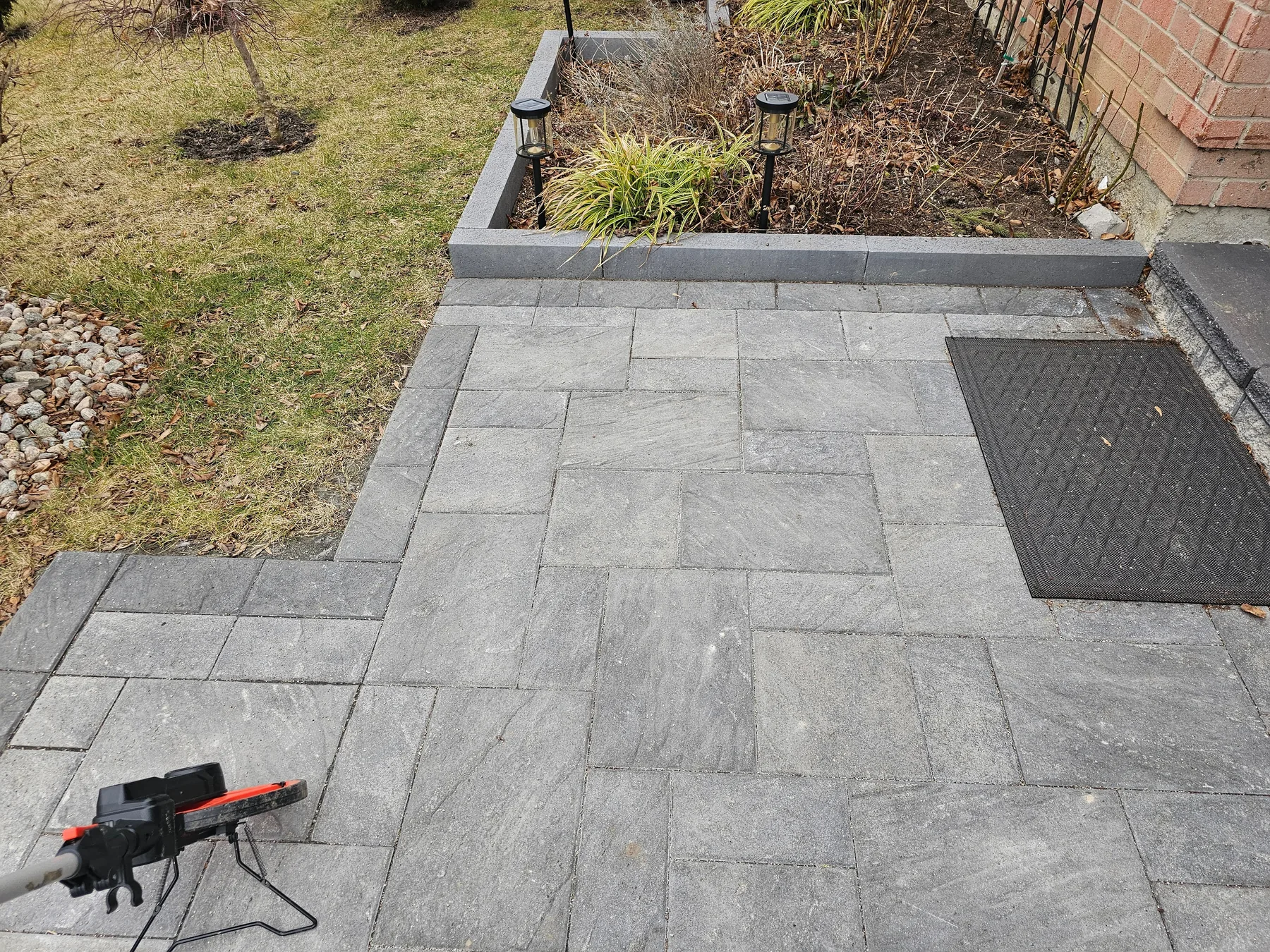
If you've requested two or three quotes for an interlocking job and the prices came in across a $10,000 range, you're not alone — and the spread is usually real, not negotiation room. Here's what interlocking actually costs per square foot in the GTA in 2026, what you're paying for, and how to tell a fair quote from a future repair job.
The short answer
For a properly built interlocking installation in the GTA in 2026, expect:
- Walkways and small front entries: $28–$40 per square foot installed
- Driveways (standard pavers): $24–$32 per square foot installed
- Patios (standard pavers): $26–$36 per square foot installed
- Premium pavers (large-format, designer lines): $32–$45 per square foot installed
- Natural stone (flagstone, granite): $38–$60 per square foot installed
Below $20 per square foot for any of these in the GTA in 2026 is almost always a corner-cutting quote. Above $50 is either premium materials, a difficult site, or a contractor pricing for a wait-list.
What's included in a fair installed price
The number on a quote should cover all of the following:
- Excavation down to 8–12 inches below finished grade
- Geotextile separator fabric between subsoil and base
- Granular A base (6–8 inches), compacted in 2–3-inch lifts
- Bedding sand layer (1 inch of clean concrete sand, screeded flat)
- Pavers themselves (the visible product)
- Cutting and laying (bond pattern set, edges cut to fit)
- Edge restraints (steel or aluminum, never plastic)
- Polymeric jointing sand (locks pavers in place)
- Compaction and final wash of polymeric sand
- Cleanup and disposal of removed material
If any of these is missing or marked "extra" on a quote, the quote isn't apples-to-apples with the others on your kitchen table.
Standard pavers: typical ranges
Standard pavers are the workhorse lines from Unilock, Techo-Bloc, and Permacon — products like Unilock Hollandstone, Techo-Bloc Blu, Permacon Mondrian. They're 60–80 mm thick, classic patterns, and they perform fine for decades.
Installed pricing for standard pavers in 2026:
- Driveways: $24–$32 per square foot
- Walkways: $28–$40 per square foot (smaller jobs cost more per square foot due to fixed setup)
- Patios: $26–$36 per square foot
A typical 600 sq ft GTA two-car driveway in standard pavers: $14,400–$19,200 installed.
Premium pavers: when the upcharge is worth it
Premium pavers are the large-format, designer-textured lines: Unilock Beacon Hill Flagstone, Techo-Bloc Blu 60 Smooth Premiere, Permacon Mega-Lafitt. They're heavier (80 mm+), often have hand-textured surface treatments, and the pattern options are dramatic.
Installed pricing for premium pavers in 2026:
- Driveways: $32–$45 per square foot
- Walkways: $35–$48 per square foot
- Patios: $34–$48 per square foot
A 600 sq ft GTA driveway in premium pavers: $19,200–$27,000 installed.
The upcharge is typically 30–45% over standard. For a forever home or a curb-appeal upgrade where you'll see the result every day, the premium lines are noticeably better-looking and the price reflects the manufacturing cost of the texturing, not contractor margin.
Why some quotes are 30% lower
A few contractors will quote interlocking at $14–$18 per square foot. The mathematics of how that's possible:
- Skipping geotextile fabric (saves ~$0.50/sq ft but lets weed roots and silt mix into base)
- 3–4 inches of base instead of 6–8 (saves ~$3/sq ft but settles within 2 winters)
- Plastic edging instead of steel (saves ~$2/sq ft but rots and lets edge pavers drift in 5 years)
- Cheaper pavers from generic suppliers (saves ~$1–$2/sq ft, but freeze-thaw spalling within 8 years)
- No polymeric sand, just regular sand (saves ~$0.30/sq ft but joints wash out, weeds grow, freeze-heave begins)
Each of these alone is recoverable. Combined, you have a driveway that looks great on year one and is on its way back to the truck by year six. We're called in to repair these jobs constantly — and the repair cost is usually 60–80% of a brand-new build.
What drives a quote higher
A higher-than-average quote often reflects real site conditions:
- Significant slope (more excavation, more compaction effort)
- Removal of existing surface (asphalt or old interlocking)
- Drainage issues requiring a French drain or catch basin
- Tight access (no driveway frontage, wheelbarrow loading)
- Custom patterns or curved edges (more cutting, more waste)
- Step-downs or retaining walls integrated into the build
- Sealing on day-one (we recommend waiting 6–12 months, but if you want it sealed at handover, that's $1.50–$3 per square foot)
If your quote is high and you can't see which of these applies to your site, ask the contractor to walk you through it line by line. Reputable installers will.
Walkways, driveways, and patios — why prices differ
Walkways carry a higher per-square-foot price than driveways because:
- The total square footage is small, so fixed costs (setup, equipment delivery, base material truck minimums) get spread across fewer feet.
- Walkways usually have more curves, more cuts, more transitions to grade.
- Walkways are at human-eye height — finish work matters more.
Patios fall in the middle: larger than walkways, but more finish-sensitive than driveways. Most patios also need a more careful slope (1–2% away from the house for drainage) than a driveway.
How Reformity prices interlocking
Every quote we send is line-itemed:
- Square footage measured and shown
- Paver brand, line, and SKU specified
- Base depth specified (we go to 8 inches as standard, deeper on heavy-load driveways)
- Edge restraint type specified (steel or aluminum)
- Polymeric sand brand specified
- Old surface removal included or quoted as a separate line
- Drainage assessment included with recommendations if applicable
If anything moves during the build (typically site discoveries — a buried oil tank, unexpectedly bad subsoil), we stop, document, and get your sign-off on the change order before continuing. No surprises at invoice time.
Reformity's interlocking crew has been building driveways, patios, and walkways in the GTA for years. We don't lowball quotes to win work — and as a result we're rarely the cheapest number on the kitchen table. We are, reliably, the one that doesn't end up costing more after year 5.
Ready to price your project?
If you're researching a driveway or patio and want a written, line-itemed quote based on your actual lot, request a free on-site visit. We measure, look at drainage, talk through pattern and material options, and send a price within 48 hours. We also do concrete and asphalt if you decide interlocking isn't the right fit for your project.
Related Services