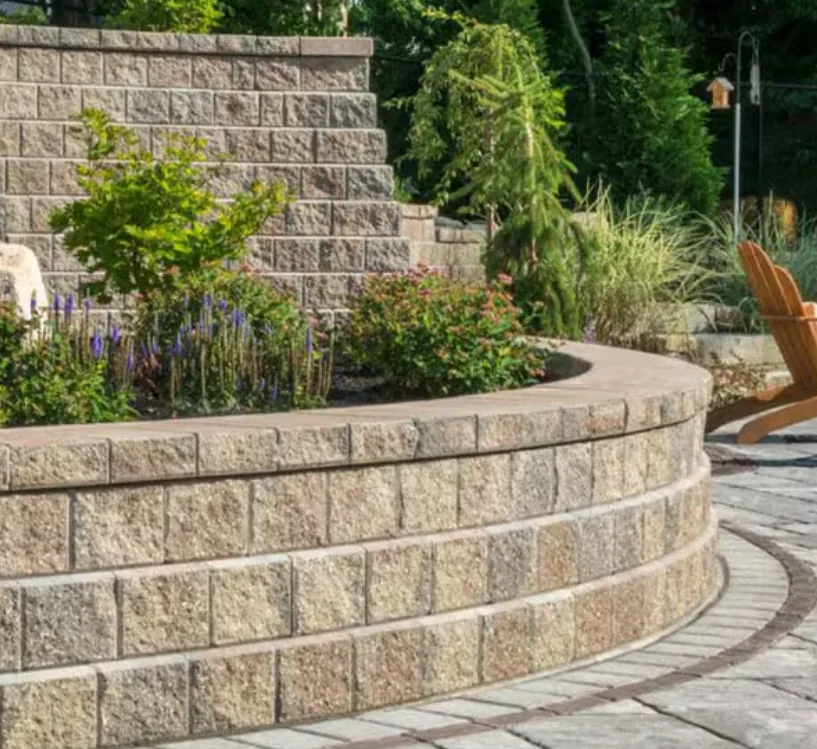
"Should I go interlocking or concrete?" is the most common question on a driveway quote. Both are great products. The right answer depends on your lot, your budget, and how long you plan to be in the house. Here's the honest breakdown, based on actual 2026 GTA install costs and what we see on jobs every week.
The short answer
For a typical GTA single-car or double-wide driveway, concrete usually wins on first-day cost; interlocking usually wins on lifetime cost and resale value. Both are durable. The differences are in repair difficulty, curb appeal, and how each handles two decades of freeze-thaw.
Installed cost: 2026 numbers
These are typical installed ranges in the GTA right now (2026), assuming a removal of the existing surface and a properly compacted granular base:
- Plain broom-finish concrete driveway: $14–$22 per square foot
- Stamped or decorative concrete: $22–$32 per square foot
- Standard interlocking pavers (Unilock / Techo-Bloc / Permacon entry lines): $24–$32 per square foot
- Premium interlocking pavers (large-format, designer lines): $32–$45 per square foot
For an average GTA two-car driveway of 600 square feet, that's roughly:
- Plain concrete: $8,400–$13,200
- Standard interlocking: $14,400–$19,200
- Premium interlocking: $19,200–$27,000
If you're getting quotes far below these ranges, ask hard questions about the base build. Most failures we're called in to repair are bases that were cut short, not the surface material.
Lifespan: where interlocking pulls ahead
A properly built interlocking driveway in the GTA lasts 25 to 30 years with one mid-life re-sanding of the joints (typically year 8–10). A properly poured concrete driveway lasts 20 to 25 years, with hairline surface cracks usually appearing within the first 5 — that's a property of the material, not a defect.
The reason interlocking lasts longer in the GTA specifically is freeze-thaw. Concrete is a monolithic slab. When the ground heaves, the slab cracks. Interlocking pavers are independent units sitting on a flexible base — they shift with the ground and settle back. A heaved paver can be lifted and re-set in 10 minutes. A cracked concrete slab is a saw-cut-and-patch job that never quite looks right.
Repair: a real-world story
Consider a 10-year-old driveway with one bad section near the garage door. With interlocking, Reformity's interlocking crew pulls up the affected pavers, fixes the base, and re-lays the same pavers — a half-day job, often invisible after polymeric sand cures. With concrete, the patch is a saw-cut rectangle, a colour-mismatched pour, and a visible seam that no amount of staining hides.
This is the single biggest reason we recommend interlocking for homeowners who plan to stay in the house 10+ years.
Curb appeal and resale
In the GTA market, interlocking driveways consistently appraise higher than concrete on the same lot. Realtors in Brampton, Mississauga, and Vaughan we work with regularly cite a $5,000–$15,000 perceived-value bump for a recent interlocking install vs. a recent plain-concrete one. Stamped concrete narrows that gap but doesn't usually close it.
For a forever home, the math is heavily on interlocking's side. For a home you plan to sell in 2–3 years, plain concrete is the better bet on a pure dollars-back basis.
GTA-specific: freeze, salt, snowplows
A few things to know about how each surface handles a Canadian winter:
- Concrete and de-icing salt: chloride-based salts attack concrete's surface and cause spalling. Penetrating sealers help, but salting heavily for 20 years will visibly damage even a good pour. Sand or calcium magnesium acetate (CMA) is gentler.
- Interlocking and salt: modern pavers are sealed at the factory and salt is generally fine. Joint sand can wash out over time and needs topping up every 5–7 years.
- Snowplows: both surfaces are fine for plows if the operator runs the blade slightly off the surface. Plow-blade scrape damage is more visible on concrete because the entire slab is one piece.
What drives the per-square-foot cost up or down
Same materials, different sites, different prices. Cost-drivers we see most:
- Removal of the existing surface. A 10 cm-thick old asphalt layer adds $2–$4/sq ft to the quote vs. a bare lot.
- Site grading and drainage. If the driveway needs re-grading or a French drain to handle runoff, expect another $3–$8/sq ft.
- Slope. Steep approaches add labour for excavation and base compaction.
- Curb cuts and edging. Aluminum or steel edge restraints add $4–$6 per linear foot — and they're not optional on a proper interlocking job.
- Access. If the truck can't get within 30 m of the driveway, expect a wheelbarrow surcharge.
Verdict by scenario
- Forever home, want it to look great in 20 years: interlocking, premium pavers if the budget allows.
- Tight 2026 budget, plan to sell in 5 years: plain broom-finish concrete.
- Curb appeal upgrade for resale next year: stamped concrete (cheaper than interlocking, looks great fresh).
- Climbing slope or drainage trouble: interlocking — it can be lifted to fix base issues without re-pouring.
- Heated driveway (snowmelt cables): interlocking — heating systems are designed to be re-accessed for repair, and interlocking pavers come up cleanly.
How Reformity builds either surface
We over-engineer the base on both products: minimum 8 inches of compacted granular A on a geotextile separator for interlocking, 6 inches plus rebar/wire mesh for concrete. We install steel edge restraints on every interlocking job (most failures we repair are from missing or rotted plastic edging). For concrete, we use a 4000 PSI mix instead of the standard 3000 PSI, embed reinforcement, and cut control joints to spec so cracks happen where you want them — at the joints.
If you'd rather just be told straight what your driveway should be, request an on-site quote. We'll measure, look at your drainage, listen to how you'll use the space, and give you a fixed price with a fixed timeline.
Related Services