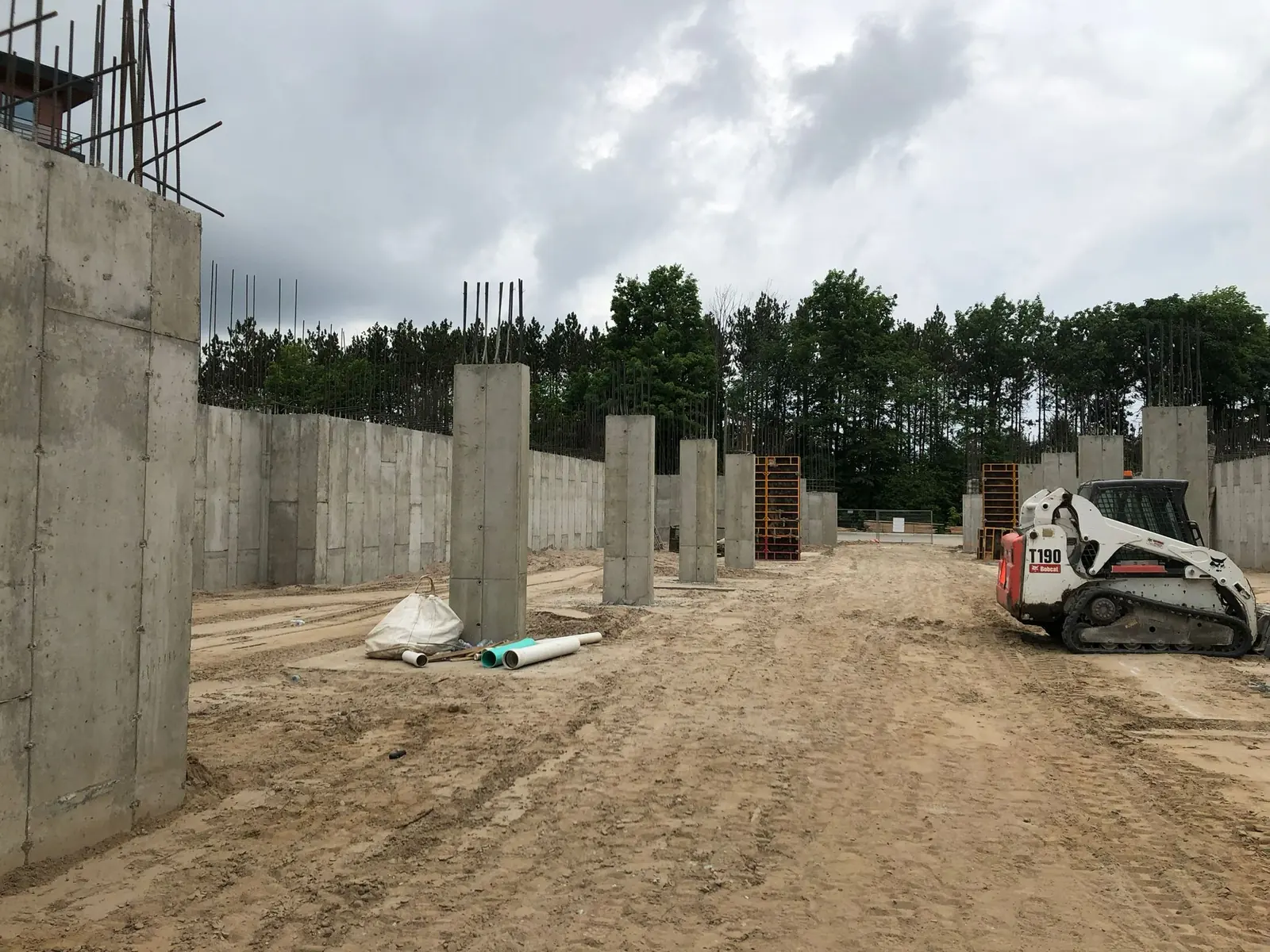
Most industrial facilities in the GTA eventually need outdoor concrete work that has nothing to do with the main yard or loading dock: a pad for a backup generator, a containment curb around a diesel or waste-oil tank, a slab for a transformer, or an enclosure for dumpsters and recycling bins. These are small-footprint projects, but they come with specific engineering and regulatory requirements that general yard paving doesn't — and getting them wrong can mean a failed fire inspection, a spill liability exposure, or a costly redo.
This post covers what Brampton, Mississauga, Vaughan, and Toronto-area facility operators need to know before specifying an equipment pad or containment system.
When You Need a Pad vs. When You Need Containment
Not every outdoor unit requires the same treatment.
A standard equipment pad is appropriate for dry equipment with no spill risk — HVAC condensers, compressors, electrical transformers (non-oil-filled), emergency generators with integral double-walled tanks, and dumpster/recycling enclosures. The main concerns are load-bearing capacity, levelness, frost protection, and (for generators and transformers) clearances from the building per the Ontario Fire Code and electrical safety requirements.
Spill containment curbing is required — or strongly advised — wherever bulk liquids are stored outdoors: diesel or fuel oil tanks, waste oil drums, chemical totes, propane (regulated separately by the Technical Standards and Safety Authority), and any above-ground storage tank (AST) covered under Ontario's environmental spill prevention framework. The containment structure needs to physically hold back a spill — it's a curbed or bermed slab, not just a flat pad.
A good rule of thumb: if a failure of the container could release liquid onto soil, pavement, or toward a catch basin, you need containment, not just a pad.
Regulatory Drivers You Should Confirm Before Building
Several overlapping sets of rules can apply, and the right ones depend on what's stored and how much:
- Ontario Fire Code — setback distances from property lines and buildings for generators, fuel storage, and flammable/combustible liquids; may also dictate fire-rated separation or bollard protection.
- Environmental Protection Act (Ontario) and MECP spill prevention expectations — facilities storing petroleum products or hazardous substances outdoors are generally expected to have secondary containment sized to hold the full volume of the largest container plus a safety margin (110% is a commonly used industry benchmark, though exact requirements depend on what's stored and local MECP guidance).
- TSSA requirements — apply specifically to fuel oil, propane, and certain pressure equipment installations, with their own pad, clearance, and signage rules.
- Municipal site plan agreements — many industrial properties in Brampton, Mississauga, and Vaughan were approved with site plan conditions that specify outdoor storage areas, screening, and drainage; adding a new tank or pad after the fact may require a site plan amendment.
- Building permits — a slab-on-grade pad under a certain size is sometimes exempt, but anything supporting a structure, roof, or fencing enclosure typically needs one. Always confirm with your local building department before pouring.
Because the applicable rules depend heavily on what's being stored and the municipality, this is one area where we strongly recommend confirming specifics with your local fire department, building division, and (for larger storage volumes) the MECP or your environmental consultant before finalizing design.
Design and Construction Specs That Matter
Concrete Pad Basics
- Thickness: 125–150 mm (5–6 in) for light equipment pads; 150–200 mm (6–8 in) with rebar or fibre reinforcement for generators, transformers, and anything serviced by forklifts or trucks.
- Base: Minimum 150 mm of compacted granular base below the slab — more in poorly draining soils common across parts of Peel and Halton Region.
- Air-entrained concrete rated for freeze-thaw exposure is non-negotiable for any outdoor GTA application.
- Slope: A slight grade (1–2%) away from equipment and toward a controlled drainage point — never toward the building or a catch basin if the equipment poses any spill risk.
Containment Curb Basics
- Curb height and volume: Sized to hold 110% of the largest single container's volume (a common standard, but confirm the applicable requirement for your specific stored substance).
- Impermeable surface: The slab itself typically needs a chemical-resistant sealer or epoxy coating — plain broom-finished concrete is porous enough that petroleum products can penetrate over time.
- No uncontrolled drain: Containment areas should not have an open drain to the storm system. If drainage is needed for rainwater, it typically requires a shutoff valve or oil-water separator, inspected and operated manually.
- Bollard protection: Vehicle-accessible containment areas should have bollards to prevent impact damage — see our breakdown of protective bollards and guard rails for industrial sites for spacing and spec guidance.
2026 Cost Ranges (GTA Estimates)
| Project Type | Typical Size | Estimated 2026 Cost (CAD) |
|---|---|---|
| Standard equipment pad (HVAC, compressor) | 2m x 2m | $1,800 – $3,200 |
| Reinforced generator pad | 3m x 4m | $4,500 – $8,000 |
| Transformer pad (utility-spec) | 2.5m x 3m | $4,000 – $7,500 |
| Dumpster/recycling enclosure pad with screening wall | 4m x 6m | $9,000 – $16,000 |
| Spill containment curb (single tank, coated) | 3m x 3m | $6,500 – $12,000 |
| Multi-tank containment pad with coating & bollards | 6m x 8m | $18,000 – $35,000 |
Estimates assume standard excavation and access; sites requiring rock removal, extensive drainage rerouting, or utility relocations will run higher. Coatings, signage, and environmental consulting fees are typically quoted separately from the concrete scope.
How This Fits Into Broader Yard Planning
Equipment pads and containment areas don't exist in isolation — they interact with your yard's overall drainage and paving plan. A containment curb poured into a yard that already pools water nearby will compound problems rather than solve them. If you're planning several site upgrades at once, it's worth reviewing your industrial yard drainage and grading situation and your overall paving strategy — see our comparison of truck-rated vs. standard asphalt — before finalizing individual pad locations.
Pre-Project Checklist for Facility Operators
- Identify exactly what will sit on or be stored at the pad (dry equipment vs. liquids/chemicals)
- Confirm Fire Code setback distances with your local fire department
- Check whether a building permit or site plan amendment is required
- Determine containment volume requirements if liquids are stored (confirm with MECP guidance or an environmental consultant)
- Specify air-entrained, freeze-thaw-rated concrete with appropriate reinforcement
- Decide on coating/sealant needs for chemical or fuel resistance
- Plan drainage so runoff from the pad doesn't discharge untreated to a storm system
- Budget for bollards if the area is vehicle-accessible
- Coordinate pad location with your facility's overall drainage and traffic flow
Getting It Done Right the First Time
These are low-visibility projects compared to a new yard or loading dock, but they carry outsized liability if specified incorrectly — a containment curb that's undersized or an uncoated slab under a fuel tank can turn a minor leak into a reportable environmental incident. Working with a contractor who understands both the concrete engineering and the regulatory context (and who will tell you plainly when to bring in an environmental consultant) is worth the extra conversation up front.
Contact Reformity Inc. at /contact to discuss your equipment pad or containment project and get a detailed quote for your GTA facility.