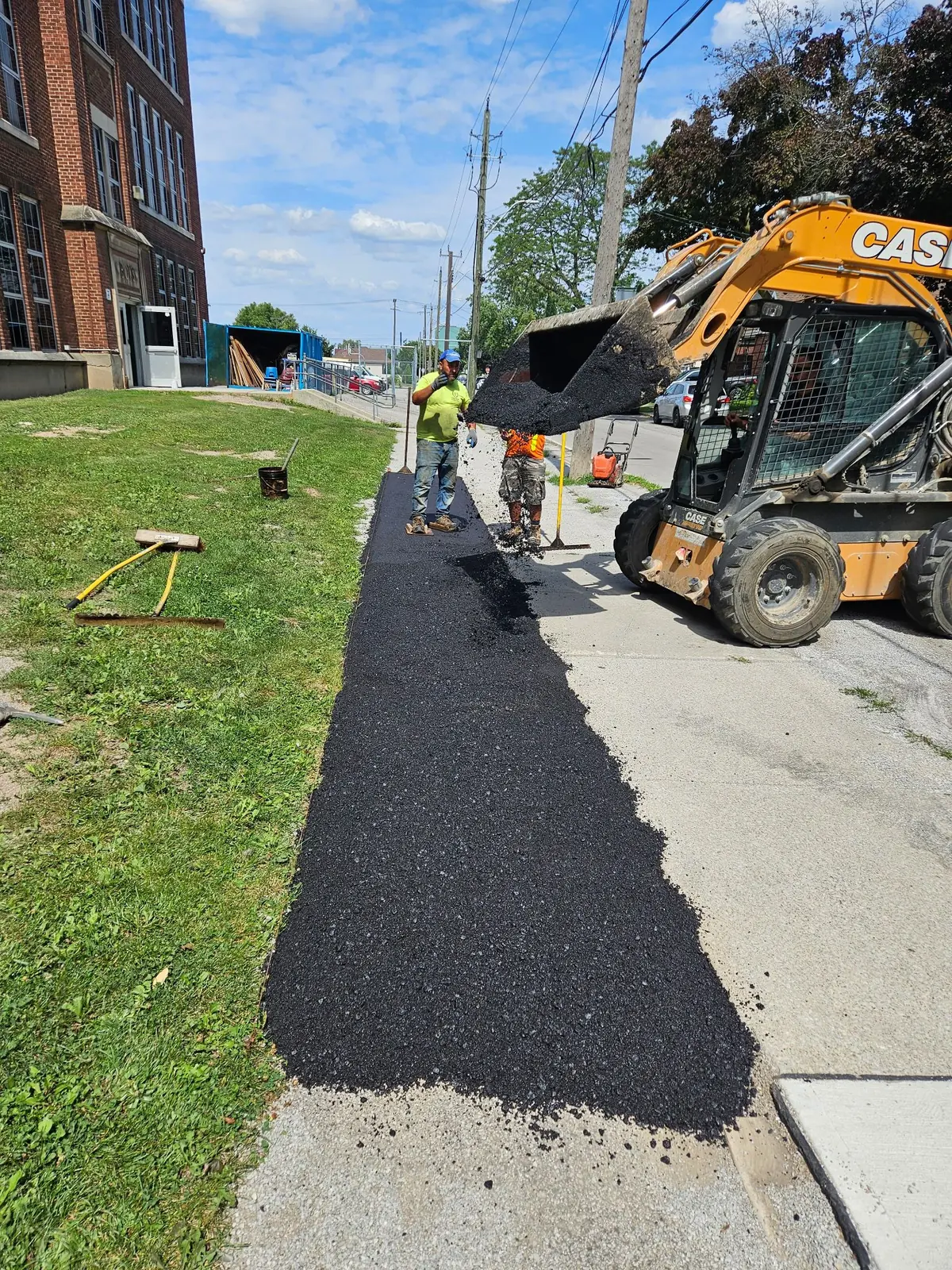
Truck-Rated vs. Standard Asphalt: Specifying Pavement for Industrial Yards
If your facility moves freight, the pavement in your yard is structural infrastructure, not a finish. Specifying a standard asphalt section for an area that sees loaded 53-foot trailers, container handlers, or constant trailer-jockey traffic is one of the most expensive mistakes a facility manager can sign off on. The surface looks identical the day it's poured. The difference shows up in year two as rutting, shoving, and alligator cracking exactly where the wheels track.
This guide explains how truck-rated (heavy-duty) asphalt differs from a standard commercial section, what to specify for a GTA industrial yard, and how to avoid paying twice.
The core difference isn't the asphalt — it's the section
Most owners assume "heavy-duty asphalt" means a tougher top mix. The asphalt mix matters, but the real difference is the total pavement section: how thick each layer is and how well the granular base and subgrade beneath it are built. A truck yard fails from the bottom up far more often than from the top down.
A standard commercial section is engineered for cars and light vans in a parking lot. A truck-rated section is engineered for repeated heavy axle loads, slow-moving turning trucks, and point loads from trailer landing gear and stacked containers. Those are completely different loading conditions.
Standard vs. truck-rated: a side-by-side
The numbers below are typical GTA ranges for context. A geotechnical report and a pavement design for your specific subgrade always govern — these are illustrative, not a spec.
| Element | Standard commercial | Truck-rated (heavy-duty) |
|---|---|---|
| Typical use | Car parking, light vans | Trailer traffic, yards, loading areas |
| Asphalt thickness | ~50–75 mm, often one lift | ~100–150 mm+, usually two lifts (binder + surface) |
| Granular base | ~150–200 mm Granular A | ~300–450 mm+ Granular A/B, often with a subbase |
| Subgrade prep | Proof-roll, basic compaction | Geotextile separation, undercut soft spots, engineered compaction |
| Drainage | Surface slope to catch basins | Slope plus subdrains where the water table is high |
| Mix design | Standard surface mix | Higher-stability binder course, often a stiffer surface mix |
The headline: truck-rated pavement is roughly twice the section of a standard lot, and most of that extra material is below the surface where you can't see it.
Where standard asphalt fails in a truck yard
Specifying a parking-lot section for trailer traffic produces predictable, repeatable failures:
- Rutting and shoving in the wheel paths and at stop bars, where slow, heavy, turning loads knead a thin section.
- Trailer gear punch-through. Landing gear and dolly legs concentrate enormous point loads on a few square inches. A thin section dimples and then cracks around the dimple.
- Alligator (fatigue) cracking in drive lanes, the classic sign the base couldn't carry repeated loads.
- Edge raveling and depressions at dock approaches, where braking and turning loads are highest.
By the time these show, the fix is rarely a simple overlay. Paving over a failed base just telegraphs the failure back through the new surface within a season or two.
Don't pave over the problem: base and subgrade come first
In the GTA, the subgrade is the variable that decides whether your pavement lasts 8 years or 20. Much of the region — large stretches of Brampton, Mississauga, Vaughan, and the 400-series corridors — sits on silty clay soils that hold water and lose strength when saturated. Freeze-thaw then heaves and weakens an underbuilt base every winter.
For an industrial yard, the right sequence is:
- Geotechnical investigation. Boreholes tell you the subgrade strength and water table. This drives the whole design.
- Undercut and replace soft spots. Don't bridge over mud — remove it and bring in engineered fill.
- Geotextile separation fabric between subgrade and granular base, which keeps the clay from pumping up into your stone over time.
- Engineered, tested granular base placed and compacted in lifts, with density tested rather than eyeballed.
- Then the asphalt — binder course first, surface course second.
Our heavy-duty asphalt and paving work starts with the section underneath for exactly this reason. The asphalt is the last thing we think about, not the first.
Drainage is part of the spec, not an afterthought
Water is the enemy of every pavement, and industrial yards are large flat catchments. If water sits or infiltrates the base, even a perfect asphalt section will fail early. For a yard, plan drainage as a system: positive surface slope to catch basins, adequate basin spacing, and subdrains where the water table is high or the soil drains poorly. Grading also has to suit how trucks actually move — you don't want ponding at dock approaches or in the trailer staging rows. This is where our grounds and drainage scope and the paving scope have to be coordinated up front rather than reconciled later.
When concrete beats asphalt — and where to mix them
Asphalt is flexible and cost-effective across large yards, but it is not always the right material for every zone. Concentrated, stationary, or super-heavy loads often justify rigid pavement:
- Dock aprons and trailer staging positions where landing gear sits for hours.
- Container stacking and reach-stacker pads.
- Compactor, baler, and waste-bin pads that see point loads and leaking fluids.
- Sharp turning radii at gatehouses where shoving destroys asphalt fastest.
A common, cost-smart approach is asphalt for the open driving and parking areas, industrial concrete for the high-stress pads. You spend the premium where the loads demand it and save across the larger field.
Ontario winters change the maintenance plan
A GTA truck yard takes a beating that a southern facility never sees: plowing, salt and brine, and dozens of freeze-thaw cycles a season. Two practical implications for your spec and budget:
- Plan crack sealing and surface treatments as a routine cycle, not a repair. Sealing cracks before water gets in and freezes is the single cheapest way to extend pavement life.
- Coordinate snow operations with pavement protection. Steel plow edges and over-aggressive scraping chew up asphalt edges and joints; the right blade setup and an established snow and ice management plan protect the surface you paid for.
A truck-rated section costs more to install but far less to own over a 20-year horizon, because you avoid the dig-out-and-redo cycle that underbuilt yards fall into every 6 to 8 years.
How to specify it right the first time
When you tender industrial paving, make sure the scope includes, at minimum:
- A geotechnical report and a pavement design tied to your actual loads (not a generic "heavy-duty" label).
- Defined granular base depth and material, with compaction density testing required.
- A two-lift asphalt section (binder + surface) with stated thicknesses and mix types.
- The drainage and grading scope, coordinated with paving.
- A maintenance schedule for crack sealing and resurfacing.
If a bid comes in well below the others, the savings are almost always hidden in the base depth or testing — the parts you can't inspect once the asphalt is down.
Talk to us before you tender
The cheapest industrial pavement is the one you build correctly once. If you're planning a new yard, expanding a logistics site, or watching a young lot rut where the trailers track, get the section reviewed before you commit. Contact our industrial team and we'll walk your site, talk through your traffic and loads, and help you specify pavement that survives both your fleet and a GTA winter.