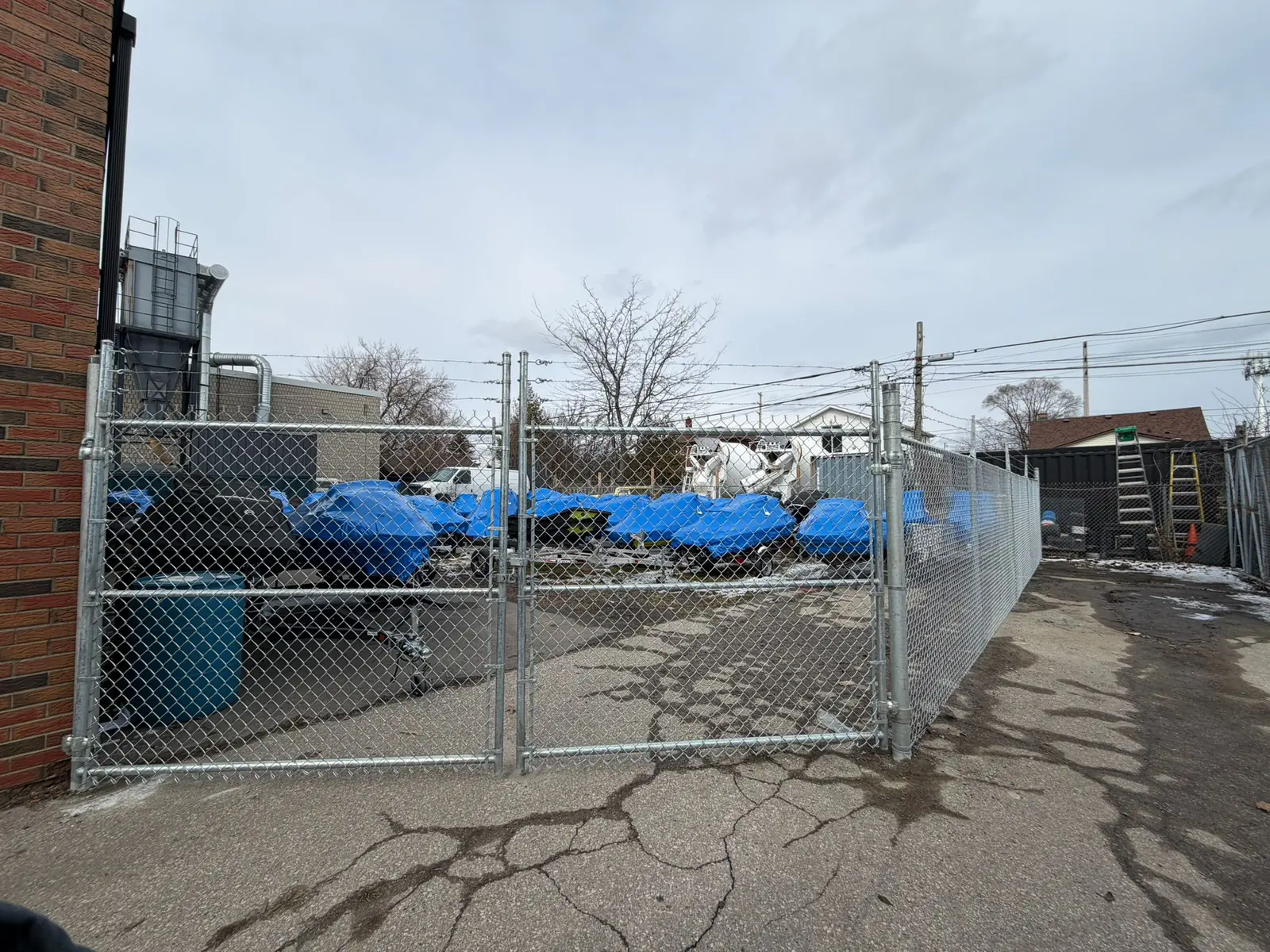
Site Security Fencing Options for Warehouses & Industrial Yards in the GTA
For an industrial property, the perimeter fence is rarely just a fence. It's the first line of insurance compliance, the boundary your trailers and equipment sit behind overnight, and often the single most visible signal to your insurer and your tenants that the site is controlled. Get it right and it disappears into the background for 20 years. Get it wrong and you're paying for repairs, theft claims, and uncomfortable conversations every winter.
This guide walks through the main perimeter options we install across warehouses, distribution yards, and industrial parks in the GTA — what each is good for, what each costs you in maintenance, and how Ontario conditions change the math.
What an industrial perimeter actually has to do
Before comparing materials, it helps to be honest about the job. A warehouse or yard fence usually has to:
- Deter and delay opportunistic theft of copper, catalytic converters, fuel, tools, and trailers
- Define a controlled boundary for liability, insurance, and (where applicable) bonded or customs zones
- Channel traffic to monitored gates and away from blind corners
- Survive GTA weather — freeze-thaw heave, road salt, plow contact, and equipment strikes
- Stay code-compliant with the local zoning and fence bylaw for the municipality
No single product wins on all of these. The right answer is almost always a combination matched to the threat level on each face of the site.
The main fencing options
Galvanized chain-link
Still the workhorse of industrial perimeters, and for good reason. Chain-link is economical per linear foot, fast to install over long runs, and easy to repair section by section. For most warehouse perimeters where the main risk is general intrusion rather than targeted attack, a properly specified chain-link line does the job.
Where it earns its keep:
- Height and gauge matter more than people think. A 6 ft, 11.5-gauge fence is a residential spec. For a yard holding trailers or equipment, 8 ft fabric in 9-gauge (or 6-gauge for high-risk faces) is the realistic minimum.
- Add a top guard. Three-strand barbed or razor outriggers add roughly a foot of effective height and dramatically increase climb time.
- Bottom rail or buried fabric stops the lift-and-crawl gap that thieves rely on.
Welded mesh ("anti-climb") panels
Rigid welded mesh — often called 358 mesh after its aperture pattern — uses apertures too tight for fingers and toes. It's the upgrade when chain-link isn't deterrent enough but you don't want the look or the wind load of solid panel. Common on the street-facing or high-value faces of a site, paired with chain-link on the back runs to manage budget.
Ornamental steel / palisade
Vertical steel picket or palisade fencing reads as a hard boundary and is genuinely difficult to climb or cut quickly. It carries a higher cost per foot but a long service life and a more finished appearance — a fit for industrial-flex buildings, head offices attached to warehouses, or any frontage where appearance is part of the leasing pitch.
Crash-rated and vehicle-mitigation lines
For sites where a vehicle-borne threat or accidental ram is a real concern — fuel depots, utility yards, sensitive logistics — fencing alone isn't the control. The boundary gets reinforced with cabling, embedded posts, or a separate line of bollards and guard rails at the gate and along vulnerable faces.
Comparing the options at a glance
| Option | Relative cost/ft | Security level | Maintenance | Best use |
|---|---|---|---|---|
| Chain-link (8 ft, 9-ga) | $ | Moderate | Low | Long perimeter runs, general deterrence |
| Welded "anti-climb" mesh | $$ | High | Low | High-value or street-facing faces |
| Ornamental steel / palisade | $$$ | High | Low–medium | Frontage, office-attached, leasing appeal |
| Crash-rated / reinforced | $$$$ | Very high | Medium | Gates, fuel, vehicle-threat sites |
Dollar signs are relative, not quotes — actual pricing depends on run length, grade, soil, and gate count. We scope each site individually as part of our industrial site services.
Gates are where perimeters fail
A perimeter is only as strong as its weakest opening, and on industrial sites that's almost always the gate. Cantilever slide gates are the standard for yards because they have no bottom track to clog with snow, ice, or debris — a real advantage in GTA winters where a track-mounted gate freezes shut by January. Key decisions:
- Cantilever vs. swing: cantilever for wide yard openings and snow zones; swing for narrower, level openings
- Manual vs. operator: automated operators with vehicle loops, keypads, fobs, or card readers for monitored 24/7 traffic
- Backup and fail-safe behaviour: define what the gate does on a power loss — fail-secure for high-risk sites, fail-safe where emergency egress governs
We size posts and footings for the gate, not just the fence. An undersized cantilever post is the most common reason an industrial gate sags within two years.
The GTA-specific stuff that wrecks fences early
Industrial fencing in the GTA fails for predictable, regional reasons. Plan around them:
- Freeze-thaw heave. Posts set in shallow or poorly drained footings get pushed up over the winter and never reseat. Footings should reach below the frost line — generally around 1.2 m in this region — on properly compacted, drained bearing.
- Road salt and brine. Salt accelerates corrosion at grade, exactly where chain-link bottom rails and post bases live. Hot-dip galvanizing, and a vinyl or polymer coat on top of it, buys years.
- Plow and equipment contact. Snow stacking and yard equipment hit fences constantly. Bottom rails, heavier posts on truck-route faces, and protective bollards at corners pay for themselves.
- Grade and drainage. Water that ponds along a fence line undermines footings and rusts steel. We coordinate fencing with the site's grading and drainage work so the two systems don't fight each other.
Bylaws, zoning, and insurer expectations
Most GTA municipalities exempt fences in industrial (employment) zones from a building permit up to a height in the 2.4 m to 3.0 m range, but height limits, barbed-wire allowances, and corner-lot daylight-triangle setbacks vary by city. Brampton, Mississauga, Vaughan, Caledon, and Toronto each publish their own fence and zoning by-laws, and barbed or razor topping is frequently restricted on faces abutting a public street or residential zone.
Separately, your insurer often has its own perimeter expectations — minimum height, gate locking standards, and sometimes lighting and camera integration. It's worth confirming both the municipal rule and the policy requirement before you finalize a spec, because the stricter of the two governs.
How we approach an industrial perimeter
We don't quote a single fence type across an entire site. We walk the perimeter, identify the high-value and high-exposure faces, and spec security where it matters while keeping budget-grade line on the low-risk runs. The package typically includes footing design for frost, gate operators sized to your traffic, coordination with grading and drainage, and a bylaw check for your specific municipality. You can see the full scope of what we install on the site security fencing page.
Plan the perimeter before the next budget cycle
A perimeter upgrade is far cheaper to plan than to react to after a break-in or an insurance flag. If you're scoping a new yard, re-fencing an aging line, or trying to close a gap your insurer has raised, we'll walk the site and put a written, prioritized plan in front of you. Reach out through the industrial contact page and we'll schedule a site visit at your convenience.