Protective Bollards, Guard Rails & Traffic Safety for Industrial Facilities
On an industrial site, almost everything expensive moves: forklifts, yard trucks, trailers, reach stackers, and the occasional driver who has never been to your facility before. Protective bollards, guard rails, and a sensible traffic plan are what stand between that movement and your building columns, your overhead doors, your gas meter, and the people on foot. They are some of the lowest-cost assets on the property and, dollar for dollar, some of the highest-returning.
This guide is written for property owners, developers, and facility managers running warehouses, distribution centres, and industrial-flex buildings across the GTA. It covers where impact protection actually pays off, how to choose the right product, and how Ontario conditions change the install.
Why impact protection is a budget line, not an afterthought
A single forklift strike on an unprotected structural column can mean an engineering inspection, temporary shoring, and a repair that closes off part of the building. A truck backing into an overhead door frame can take a dock out of service during peak shipping. Compared to those costs, a bollard is trivial.
There is also a compliance angle. Under Ontario's Occupational Health and Safety Act and the workplace requirements it carries, employers are responsible for protecting workers from hazards — and pedestrian-vehicle separation is a recurring theme in warehouse safety. Insurers and WSIB-conscious operators increasingly expect to see engineered separation between traffic and people. Impact protection is part of how you demonstrate that.
Where protection actually pays off
You do not need to armour the entire site. You need to protect the points where a strike is both likely and expensive. On most GTA industrial properties that list looks like this:
- Building corners and structural columns exposed to forklift or truck traffic
- Overhead and dock door jambs — the most frequently hit feature on any warehouse
- Loading dock edges and dock levellers, where reversing trailers concentrate
- Pedestrian doors that open directly into a drive aisle or yard
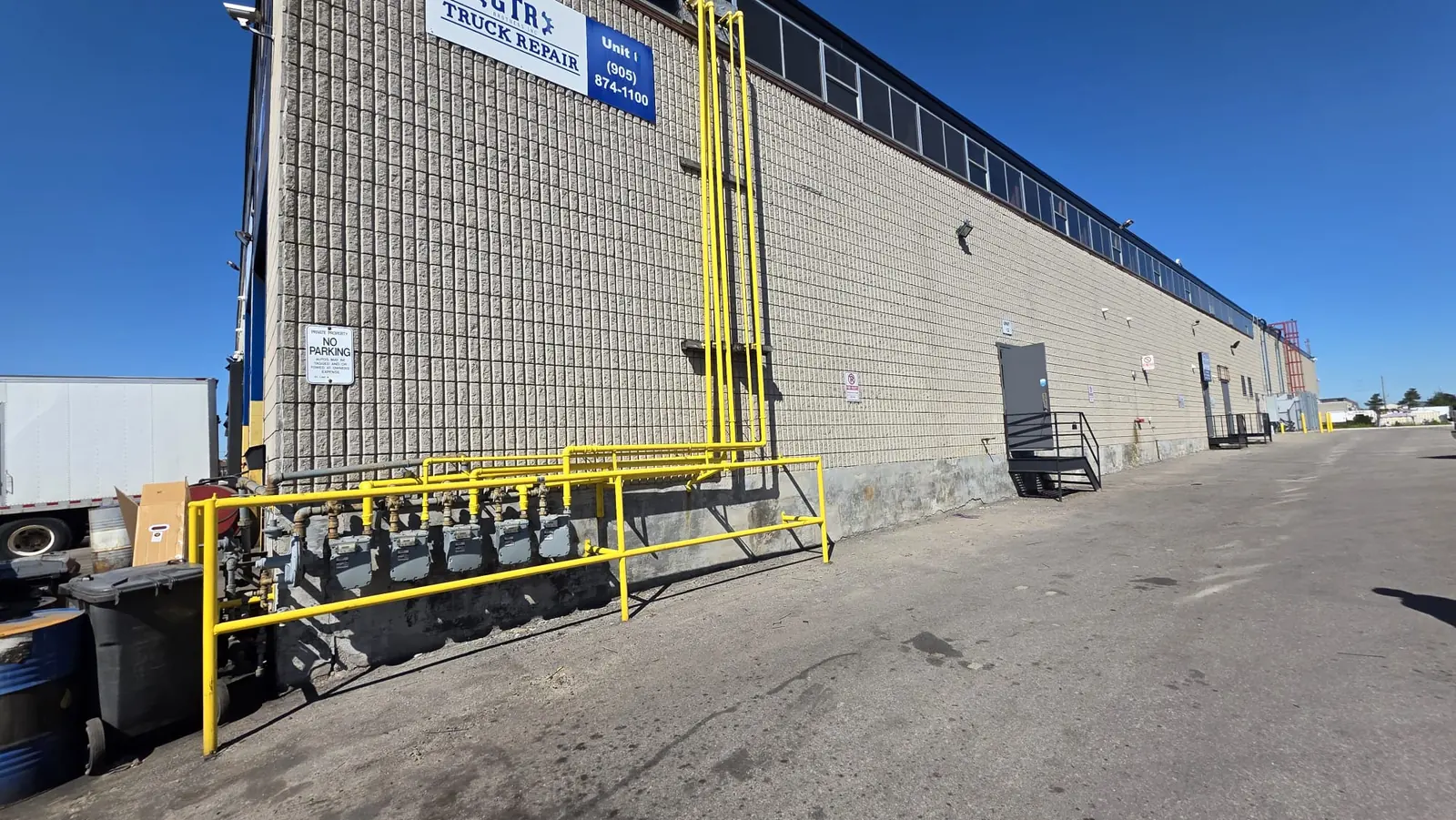
- Utility assets — gas meters, electrical transformers, fire risers, sprinkler connections, hydrants, and bollard-protected backflow preventers
- Racking ends and aisle entrances inside the building
- Pinch points and blind corners where yard trucks and pedestrians cross
A walk of the site with the people who actually drive it will surface most of these in an hour. The scuff marks and dented door frames tell you where the problems already are.
Bollards: fixed, removable, and the difference that matters
"Bollard" covers a wide range, and matching the type to the job is most of the decision.
| Type | What it does | Best use |
|---|---|---|
| Fixed steel pipe, concrete-filled | Maximum impact resistance | Columns, dock edges, utility protection |
| Removable / lift-out | Protection plus occasional access | Fire lanes, maintenance access points |
| Collapsible / fold-down | Controls access, low impact rating | Pedestrian gates, low-speed zones |
| Decorative / sleeved | Appearance over a steel core | Office-attached frontage, customer entries |
| Bolt-down / surface-mount | Fast install, lower resistance | Interior racking ends, light-duty zones |
A few specification points worth getting right:
- Concrete-filled, properly footed pipe bollards outperform surface-mounted units by a wide margin for real vehicle impact. For genuine traffic-facing protection, a buried, concrete-encased footing is the standard.
- Diameter and wall thickness should match the threat. A bollard protecting a structural column from a loaded forklift is not the same product as one defining a walkway.
- Footing depth has to clear the frost line. More on that below — it is the single most common reason a bollard tilts within a couple of winters.
- High-visibility finish matters. Safety-yellow powder coat or reflective banding turns a bollard into a wayfinding aid, not just a barrier.
If you want to see the full scope of impact protection we install, the bollards, guard rails & safety page lays it out.
Guard rails and barriers inside and out
Where bollards protect a point, guard rails protect a line. They are the right tool for runs you want to shield continuously.
- Pedestrian guard rail separates walkways from drive aisles and yard traffic, ideally creating a defined route from the parking area or door to the building entrance.
- Rack-protection rail and end-of-aisle guards absorb the constant low-speed nudges that degrade racking over time.
- Dock-area barriers and corner guards protect equipment and structure in the busiest, tightest part of the building.
- Heavy steel guard rail along yard edges, retaining walls, and drop-offs keeps trucks and trailers where they belong.
The goal is a continuous, legible system: a driver or pedestrian should be able to read the site and know where they are allowed to be without thinking about it.
Traffic flow is the cheapest safety upgrade you own
Hardware is only half of it. The layout that hardware enforces is the other half, and it is often free to fix.
- Separate people from vehicles. Defined, marked, ideally physically protected pedestrian routes from the lot to the door are the highest-impact change on most sites.
- Make the yard one-directional where you can. Counter-clockwise circulation gives drivers their best sightline and reduces head-on conflict.
- Manage blind corners with convex mirrors, signage, and reduced-speed zones.
- Coordinate striping and signage with the pavement itself. Fresh line painting, stop bars, and directional arrows only hold up on sound asphalt. We routinely package this with heavy-duty asphalt paving so the markings land on a surface that will keep them.
- Light the conflict points. Dock approaches and pedestrian crossings need to be visible in the dark and through GTA winter weather.
What GTA conditions do to your hardware
Ontario is hard on outdoor steel and concrete, and bollards and rails fail here for predictable regional reasons:
- Freeze-thaw heave. A bollard set in a shallow or poorly drained footing gets pushed up and out of plumb over winter and never reseats. Footings should reach below the local frost line — generally around 1.2 m in this region — on compacted, drained bearing.
- Road salt and brine. Salt attacks steel right at grade, exactly where bollard bases live. Hot-dip galvanizing plus a powder-coat topcoat buys years over bare or painted steel.
- Plow contact. Snow stacking and plow blades hit low bollards and rails every season. Place and rate hardware with winter equipment in mind, and coordinate with your snow contractor on stacking zones.
- Drainage and base condition. A bollard or rail post is only as stable as what it sits in. Water that ponds at the base undermines the footing — which is why we coordinate this work with site grading and exterior grounds & drainage.
How we approach an industrial site
We do not sell a single product across the whole property. We walk the site, identify where strikes are both likely and costly, and spec accordingly — heavy concrete-filled bollards on the structural and utility risks, continuous rail on the pedestrian and yard-edge runs, and a traffic layout that makes the whole thing self-explanatory. Footings are designed for frost, finishes are chosen for salt and visibility, and the work is coordinated with paving, striping, and drainage so the systems reinforce each other instead of fighting.
Plan it before the next strike, not after
The cheapest impact protection is the one installed before a column gets hit or a worker has a near-miss. If you are scoping a new build, retrofitting an aging warehouse, or closing a gap your insurer or safety committee has flagged, we will walk the site and put a written, prioritized plan in front of you. Reach out through the industrial contact page and we will arrange a site visit at a time that suits your operation.
Related Services