Toronto Landscaping Contractor · Reformity Inc.Landscaping & Grading in Toronto
Toronto's zoning decides how much of a backyard can be paved. On most house lots with more than 6 m of frontage, at least half the rear yard has to stay soft landscaping (25% on narrower lots), and patios and walkways don't count toward it. That shapes every design, whether it's a shaded semi-detached yard in Leslieville, a long Riverdale lot ending at a laneway garage, or a slope backing onto the Don or Humber valley. We fit planting, stone and drainage inside that limit.
Landscaping · real projects
Recent landscaping jobs across the GTA.
Real Reformity jobs from our project files. Customer addresses are never published.
Landscape & grading plan — Grading, drainage swale, tree protection and planting. Click to enlarge.
Retaining wall details
Drawn before we build
Drawn before we build in Toronto.
A grading and landscape plan: slopes away from the house, swales, downspout outlets, protected-tree zones, walls and planting. It's what site-alteration and tree permits ask for, and it keeps water off your foundation and your neighbour's.
Landscaping permits in Toronto
A retaining wall over 1 m high on or next to a street, a building entrance or publicly accessible land needs a building permit. Fill or regrading in the City's mapped ravine protection area needs a Chapter 658 permit with grading and drainage plans and a geotechnical report. Reformity prepares the site drawings and coordinates the application.
- Dimensions to your lot lines
- Materials, sizes and spacing
- Footing and base sections
- Code notes for the inspector
City of Toronto rules
Landscaping rules in Toronto.
Checked against official municipal and provincial sources. Lots differ, so we confirm the rules for your address at the quote visit.
Private trees
A permit is required to remove or injure a private tree with any stem 30 cm or more in diameter (measured 1.4 m up), or a tree of any size planted as a condition of a City approval or order. City street trees, and any tree in a ravine protection area, are protected at any size — this often decides where fence posts and deck footings can go.
Toronto Municipal Code Ch. 813Ravines & conservation
Properties near ravines and valleys are regulated by the Toronto and Region Conservation Authority (TRCA) and the City's ravine bylaw — decks, walls and regrading there may need extra approval.
TRCASite alteration & grading
In the City's mapped ravine and natural feature protection area, Chapter 658 requires a permit to place fill or change the grade, with a grading plan, a drainage plan and a geotechnical report. Exceptions include placing under 5 m³ of soil to maintain an existing manicured area, and grade changes in areas TRCA regulates.
Toronto Municipal Code Ch. 658Front-yard paving
Under 6 m of frontage, everything but a permitted driveway or parking pad must be landscaping; from 6 m to under 15 m, at least 50% of the front yard (60% at 15 m or more). At least 75% of that landscaping must be soft (planting, not hard surfaces), and a front yard with no driveway must be 75% soft.
Toronto Zoning By-law 569-2013Front-yard parking pads
Parking in a front yard needs a City front yard parking licence unless zoning allows it. A licensed pad is for one car, must be permeable paving and is capped at 2.2 m or 2.6 m wide depending on lot width; homes with a private driveway generally can't apply, and parts of the former City of Toronto accept no new applications.
Toronto Municipal Code Ch. 918Retaining walls
Toronto needs a building permit for a retaining wall over 1 m (3'3") high that's on or next to public property such as a street, by a building entrance, or on private land open to the public. Lower or fully private walls don't.
City of Toronto: when you need a permitRear-yard landscaping
Zoning By-law 569-2013: a house lot with more than 6.0 m of frontage must keep at least 50% of the rear yard as soft landscaping (25% at 6.0 m or less). Patios, walkways and retaining walls don't count as soft landscaping; a pool's water surface does.
Toronto Zoning By-law 569-2013Retaining walls over 1 m
Under Ontario's Building Code, a retaining wall needs a building permit when its exposed height is over 1 m (3'3") and it's next to public property, access to a building, or private property open to the public. Those walls must be designed to the Code's structural (Part 4) rules.
Ontario Building Code, Div. A 1.3.3.5
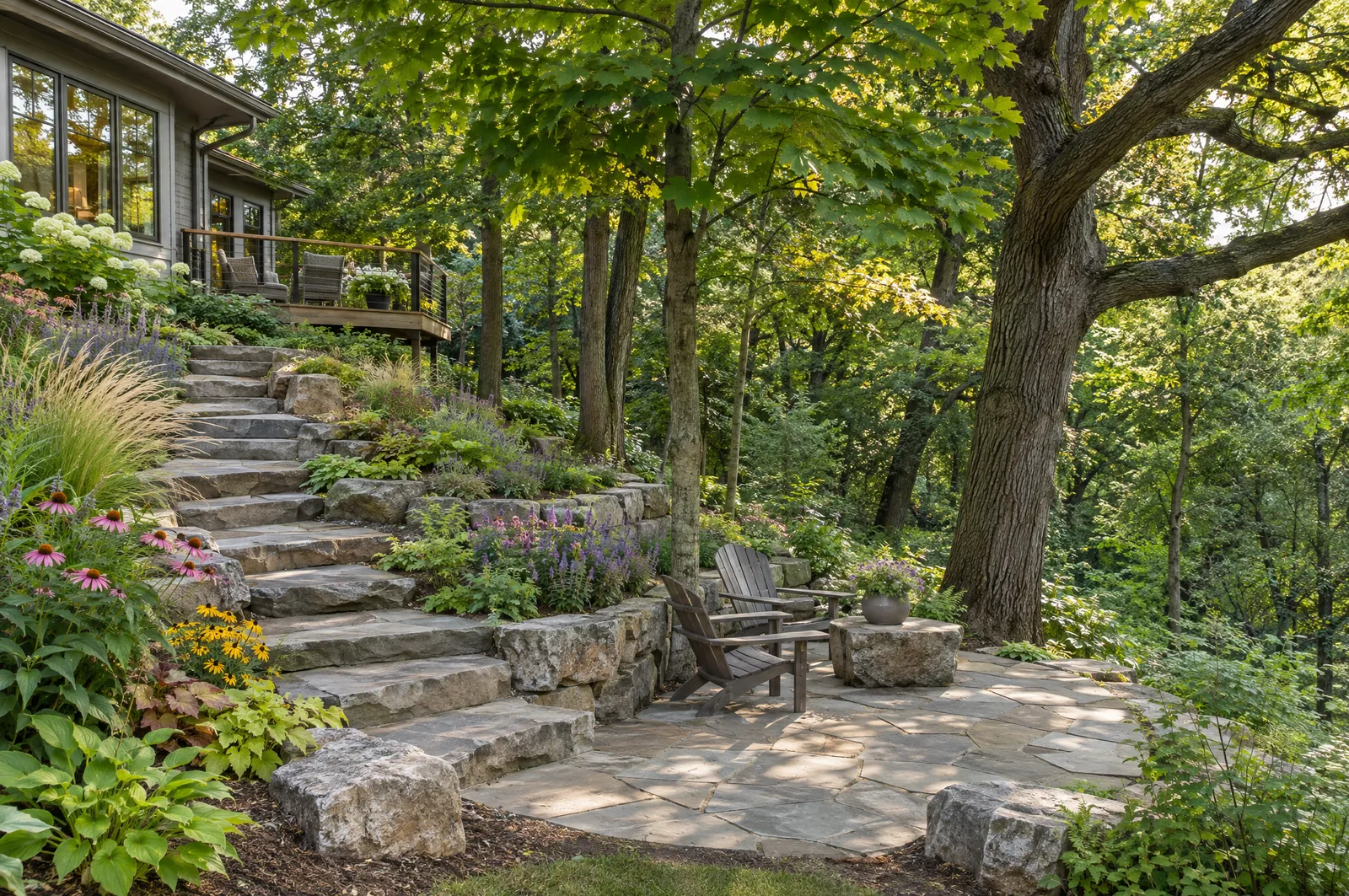
What we build in Toronto
Full-service landscaping.
- Sod Installation
- Garden Beds & Plantings
- Retaining Walls
- Drainage & Grading
Neighbourhoods
Landscaping across Toronto.
- Leaside
- The Beaches
- High Park
- Leslieville
- Riverdale
- The Annex
- Forest Hill
- Lawrence Park
- Roncesvalles
- Danforth
- Davisville
- Scarborough
Toronto Landscaping FAQ
Quick answers.
If the lot is in the City's mapped ravine and natural feature protection area, placing fill or changing the grade needs a permit under Chapter 658, backed by a grading plan, a drainage plan and a geotechnical report. Placing under 5 m³ of soil to maintain an existing lawn or other manicured area is exempt. Grade changes in areas TRCA regulates are exempt from the City permit, but TRCA's own permit can apply there, so we check both maps before designing.
A permit is required to remove or injure a private tree with any stem 30 cm or more in diameter (measured 1.4 m up), or a tree of any size planted as a condition of a City approval or order. City street trees, and any tree in a ravine protection area, are protected at any size — this often decides where fence posts and deck footings can go.
Send the form on this page or call 437-241-6287. We reply within one business day, visit your Toronto property to measure and check the City of Toronto rules for your lot, and give you a fixed written price.
Free on-site quote
Planning landscaping in Toronto?
We'll measure, check the City of Toronto rules for your lot, draw it up and give you a fixed written price. One business-day reply.