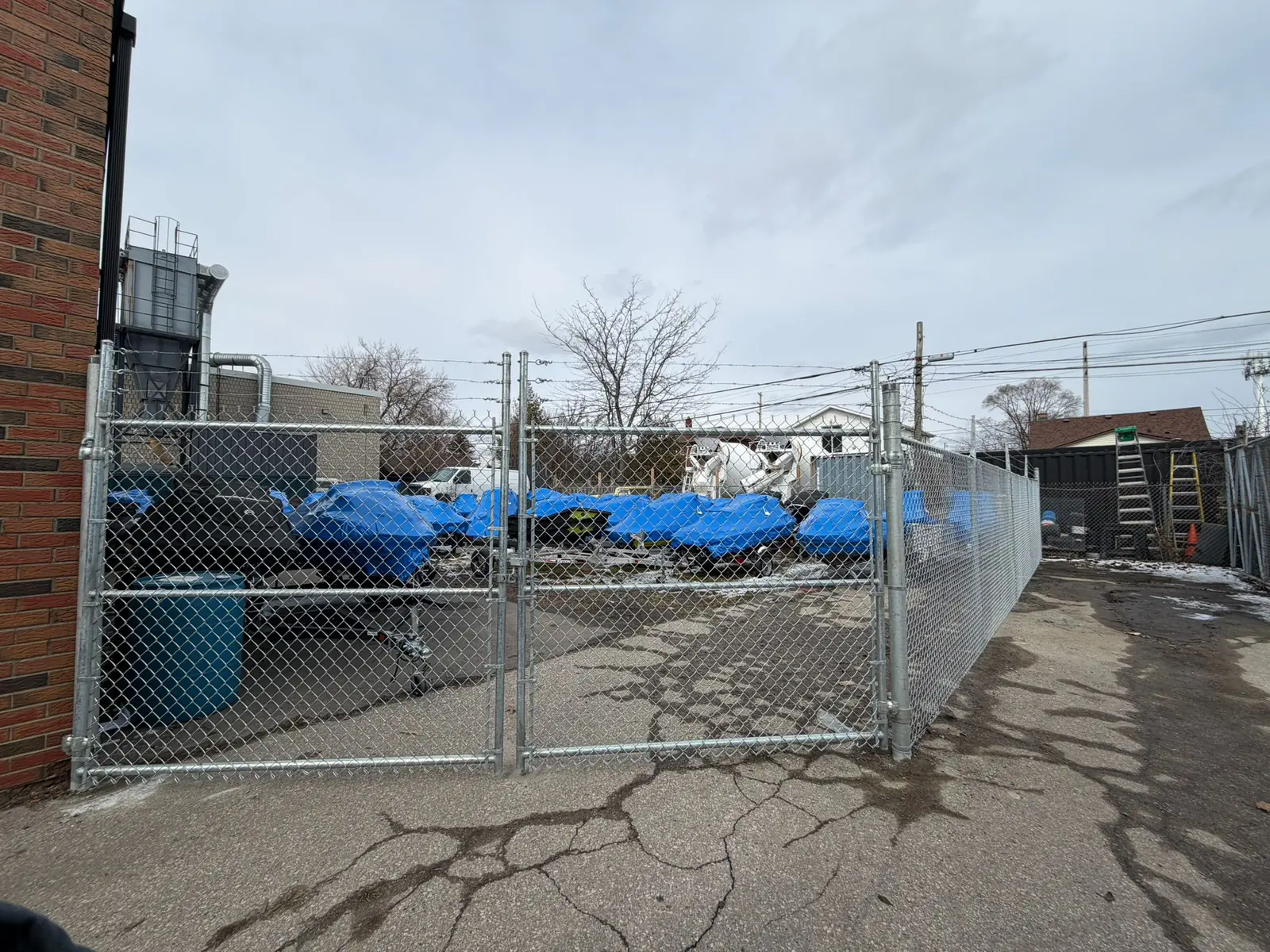
Perimeter fencing stops casual trespass, but the entrance is where most industrial sites lose control of who and what comes in. Choosing the wrong gate type — or skipping proper access control — leads to daily bottlenecks for truck traffic, after-hours break-ins, and expensive retrofits once the yard is already fenced and paved. This guide walks through the gate types, automation packages, and cost ranges GTA facility operators are specifying in 2026.
Why the Gate Matters More Than the Fence
A site can have excellent perimeter fencing (see our site security fencing guide) and still have weak access control if the gate is undersized, manually operated, or left open during shifts for convenience. For facilities handling deliveries, waste pickup, or shift-change traffic, the gate is also a throughput problem, not just a security one — a slow or narrow gate creates idling trucks, blocked fire routes, and driver complaints.
Gate Types for Industrial Applications
Cantilever slide gates roll on a track-free system supported by rollers on a steel beam, cantilevering over the opening. They're the most common choice for industrial yards because there's no ground track to clear of snow, ice, or gravel — a real advantage during GTA winters. They do require a flat run of clear ground on the side the gate slides into, roughly 1.5x the opening width.
Track-mounted slide gates run on a ground-set track and v-groove wheels. They cost less than cantilever systems and handle very wide openings well, but the track collects snow, ice, and debris, which means more winter maintenance and a higher risk of the gate binding during a freeze-thaw cycle.
Swing gates (single or bi-parting) are simpler mechanically and cost less to automate, but they need clear swing radius on both sides, which isn't always available in tight yards, and they perform worse against snow drift at the hinge side.
Vertical lift and vertical pivot gates are used where side clearance is limited (e.g., a yard tight against a rail spur or property line) but cost significantly more and are less common outside specialty applications.
| Gate Type | Typical Opening Width | Snow/Ice Performance | Relative Cost | Best For |
|---|---|---|---|---|
| Cantilever slide | Up to 40 ft+ | Good (no ground track) | Medium-High | Truck yards, wide openings |
| Track slide | Up to 50 ft+ | Fair (track needs clearing) | Medium | Budget-conscious wide openings |
| Swing (single/bi-parting) | Up to 20 ft per leaf | Fair | Lower | Smaller yards, tight budgets |
| Vertical lift/pivot | Site-specific | Good | High | Restricted side clearance |
Automation & Access Control Components
A gate operator alone doesn't manage who gets in — it just moves the gate. A functional industrial access system typically layers several components:
- Gate operator sized to the gate's weight and wind load (heavier steel gates need commercial/industrial-duty operators, not residential-grade units)
- Loop detectors or photo-eyes to prevent the gate closing on a vehicle
- Access method: keypad, proximity card/fob reader, remote transmitter, or license-plate recognition (LPR) camera for high-traffic fleet yards
- Intercom or video entry tied to a guard shack, dispatch office, or off-site monitoring service
- Battery backup so the gate still operates during a power outage — important for facilities that can't have deliveries or shift traffic stall at a dead gate
- Manual release/override for fire department and emergency access, which ties directly into fire route compliance obligations (see our guide to fire route compliance for industrial facilities)
For multi-tenant industrial parks or sites with scheduled carrier pickups, integrating the gate with a dispatch or yard management system (so drivers get a one-time code tied to their appointment window) is increasingly common and reduces guard-shack staffing needs.
Site & Climate Considerations in the GTA
- Grading: the gate's travel path and the ground beneath a cantilever gate's counterbalance need to be graded and compacted so the gate doesn't settle or bind — this is a job for whoever is already doing your yard surfacing, not an afterthought bolted on later. Poor grading is a leading cause of gate failure within the first two winters.
- Power supply: most operators run on 120V with a transformer down to 24V DC; if the gate location is far from a power source, trenching for conduit adds cost — budget for this early rather than discovering it mid-project.
- Setbacks and sightlines: municipalities generally require gates to open without swinging into the public right-of-way, and fire access routes have minimum clear width requirements that an undersized or poorly placed gate can violate. Zoning and setback specifics vary by municipality — our industrial fence permit and zoning guide covers the broader permit picture, but always confirm gate placement with your local building department before pouring footings.
- Freeze-thaw: footings for gate posts and cantilever support structures need to go below the frost line (typically 4 ft in the GTA) — a shallow footing is the most common cause of a leaning or binding gate by year three.
2026 Cost Ranges (Estimates)
| Item | Estimated 2026 Cost (CAD) |
|---|---|
| Manual swing gate (single leaf, chain-link, up to 20 ft) | $3,500 – $7,000 |
| Manual cantilever slide gate (up to 30 ft) | $6,000 – $12,000 |
| Gate automation (operator, photo-eyes, basic control) | $4,500 – $9,000 added |
| Access control (keypad or card reader, single point) | $1,200 – $3,000 |
| LPR camera system (per lane) | $5,000 – $12,000 |
| Intercom/video entry tied to guard shack | $2,000 – $6,000 |
| Electrical trenching/power run (per 50 ft) | $1,000 – $3,000 |
| Battery backup system | $800 – $2,000 |
These ranges assume commercial/industrial-duty equipment rated for daily heavy-truck-adjacent use, not residential-grade hardware. Exact pricing depends on opening width, gate weight, existing electrical infrastructure, and site grading. Get a written quote that breaks out the gate, operator, access control, and electrical work as separate line items — bundled quotes make it hard to compare contractors or identify where costs can be trimmed.
Maintenance Checklist
- Inspect rollers, hinges, and tracks for wear or debris every quarter
- Test battery backup and manual release monthly
- Clear ice and snow buildup from track-slide systems and swing gate hinge zones after every significant snowfall
- Confirm loop detectors and photo-eyes are functioning before winter (snow and road salt spray can interfere with sensors)
- Re-torque bolts on cantilever counterweight systems annually
- Review access credential lists quarterly and deactivate former employees/vendors promptly
Planning a Gate Project
Gate automation is easiest to budget correctly when it's planned alongside your fencing and yard surfacing rather than retrofitted. If you're already scoping perimeter fencing or yard regrading, loop the gate location, power run, and footing depth into that same design pass so you're not trenching through finished asphalt a year later.
Reach out through our contact page for a site assessment and a quote that breaks out gate hardware, automation, and access control separately.